
Three Routes to Resilient Architecture for the Future of Your Bank

In modern banking, customers expect intuitive, instant, always-on financial experiences—but the systems underlying many institutions are typically designed for a slower, branch-led world. This mismatch constrains innovation, agility, and resilience, and our research confirms legacy cores are one of the biggest obstacles to modernization.
Banks that thrive today are those that can adapt rapidly: launching products in days, integrating partners seamlessly, redesigning journeys quickly, and scaling without friction. Recognized by analysts and proven by banks of various shapes and sizes, composable banking has emerged as a defining architectural strategy.
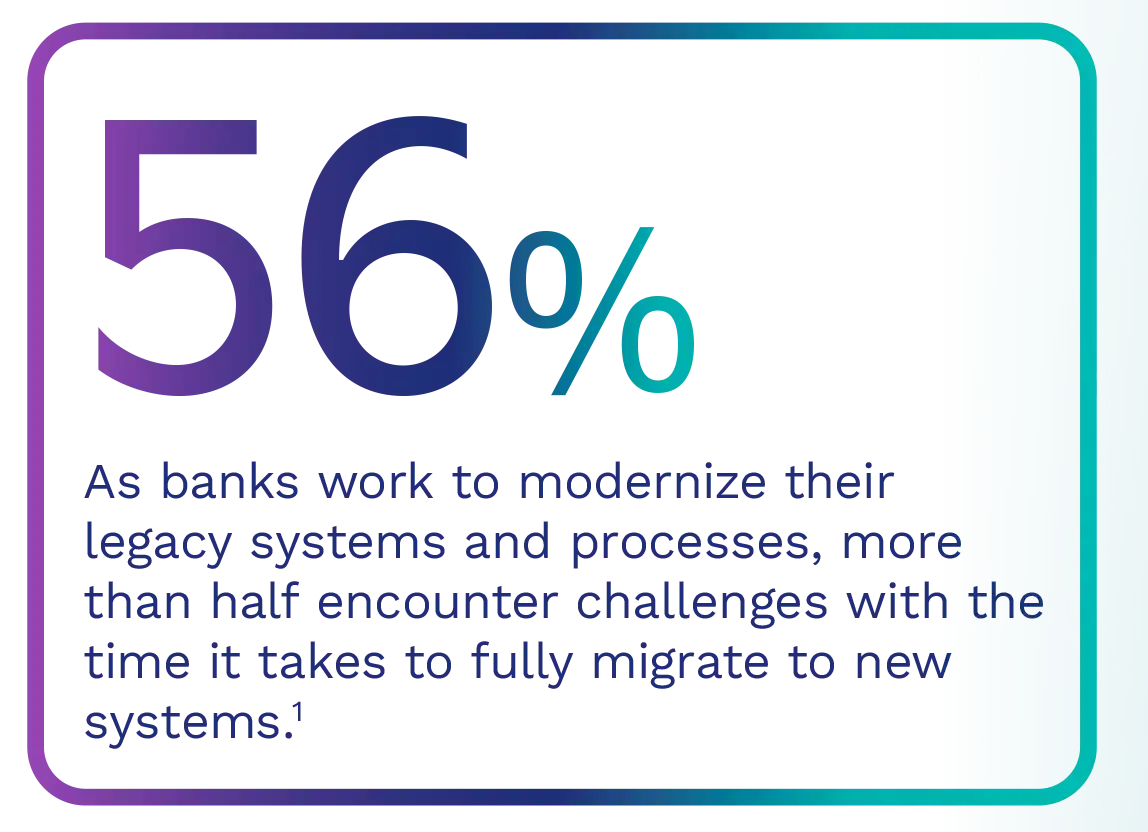
[1] Source: Hanover & Temenos 2025 Survey under 400+ banking executives ‘Modernizing Banking Solutions’
The composable modernization journey: turning complexity into modular control
Banks with more complex technical landscapes often consider carving out high-value domains like payments or product engines and rebuilding them as independent components with clear boundaries, dedicated data stores, and headless interfaces. This approach reflects modern architectural thinking rooted in packaged business capabilities and microservices principles. Each module operates as a self-contained, high-efficiency capability that progressively reduces reliance on legacy systems and supports adaptable, future-ready architecture.
A composable banking approach to core banking architecture offers complex banks a practical path to modernization without the disruption associated with full-stack replacement. By structuring the landscape around discrete, high-value capabilities, banks can innovate rapidly while progressively reducing their reliance on legacy systems. At the same time banks can centralize functionality like pricing and party management outside the core systems to gain control of critical elements that, today, are usually scattered and duplicated across existing systems.
This kind of architecture is intentionally loosely coupled, flexible, and headless, enabling real-time operations through APIs and event-driven patterns. This path supports specialized fit-for-purpose functionality rather than requiring extensive customization to meet advanced banking requirements.
For institutions that must balance change with operational stability, composability also enables incremental upgrades. Individual components can evolve independently, maintaining backward compatibility and minimizing integration overhead. This ensures that core capabilities remain current while limiting disruption to business as-usual activities.
Combined with cloud native and microservices based foundations, this approach enables banks to scale individual modules as processing volumes shift, while improving resilience across the broader architecture. A key consideration in more complex core landscapes is how product and customer data are consistently managed across the broader architecture. When banks decouple ledgering from product systems, banks can significantly contribute to consistent, real-time data that enables a single customer view and support continuity across core system as positions are always available independent core systems.
With data expectations rising, composable architecture also enables real-time data flows, personalized interactions, and seamless customer journeys, supporting deeper insight and more tailored propositions.
In summary, especially for larger or more complex banks, this approach offers a controlled, low-risk pathway toward a modern, resilient, and continuously improving technology estate.
FROM:
Core monoliths built on legacy code, with tightly coupled products, limited transaction processing scaling, fragmented data — undermining resilience, upgrades, slowing time to market, and limiting a unified customer view.
TO:
Composable architectures, built around real-time, modular service domains, form a critical foundation for long-term agility, data consistency, and architectural longevity, to get ready for AI adoption.
The Point solution approach to accelerate and augment
Rather than re-platforming the entire core, this approach enables banks to decouple and modernize a specific functional domain—such as payments, or fraud detection—while existing core systems continue to operate or are modernized in parallel. Point solutions are therefore well suited to situations where modernization is driven by a defined business objective, regulatory requirement, or growth initiative, rather than the need for broad architectural change.
In practice, banks frequently use point solutions to support entry into new markets or business segments, where speed, differentiation, and compliance are critical, or to introduce capabilities not yet available within their current systems. This often includes services that augment core and payment processes, such as fraud detection, card services, identity verification, or risk management.
By focusing on discrete capabilities, banks can apply modern integration and testing techniques to maintain a resilient, agile, and secure technology landscape. This is particularly important as point solutions at the edge of the core typically evolve faster, reflecting rapid digital innovation and regulatory change. As a result, banks can better manage transformation risk while delivering tangible, near-term business outcomes.
Learn how you can leverage Temenos Solutions.
FROM:
Limited capabilities in existing systems need heavy change to cover a specific capability, that possibly depends on parallel changes and transformation projects that impact time-to-value.
TO:
Adopt ready for use and proven capabilities as separate, upgradable solutions to augment the landscape with a modern capability in a limited time span for rapid time to value.
The SaaS-led modernization journey: Minimize time to value, maximize client focus
Let’s start with what SaaS delivers: Banks get direct access to a banking platform and configurable software – without the process of deploying, maintaining or running the underlying software and infrastructure themselves:
- One service to configure financial products, up to end-to-end banking
- One toolset for integration and extension across capabilities to diversify
- One proven governance model
- Predictable upgrade paths for the future
At Temenos, we see SaaS as a key approach to reducing complexity, lowering costs, and shortening delivery cycles, making it well suited for banks seeking maintainability and predictability.
While in-house managed core and digital applications often require significant effort to deliver consistent experiences, SaaS enables banks to leverage proven capabilities and processes through a single service. This allows banks to easily launch competitive banking offerings in days or weeks, rather than months or years. And by adopting a standardized delivery model, banks also gain greater predictability in how these capabilities are onboarded, how they evolve, and how they are supported.
But as mentioned earlier in the paper, many decisions around modernizing critical banking processes have far-reaching implications. Deciding to consume Software-as-a-Service might take this to another level: this is not a technical or operational decision, but a strategic, boardroom-level decision. It goes beyond architectural designs and functional requirements, as it also affects how critical processes are governed and how the organization is structured around them. For banks, SaaS is a strategic choice and an opportunity to organize around business outcomes, rather than managing the mechanics.
Today, many banks still run core systems on-premises, and while moving workloads to the cloud offers clear benefits, it also introduces new demands for governance, skills, and staffing. This is where SaaS is an appealing alternative to leverage the benefits of the cloud, but without the need for deep additional focus on running the underlying technology, as this is provided by the vendor in partnership with the hyperscalers: Expertise, cloud platform management, operations and related manpower are built into the service, reducing upfront investment, and the need for large technical and operations teams.
What remains critical for SaaS, however, is that material service provider arrangements supporting critical banking processes require a clear and well-established governance model. As such, banks need mindful that inclusive governance—spanning business, technology, risk, compliance, legal, security and third-party providers—is essential to maintain effective oversight, operational resilience, and regulatory confidence.
In summary, while adopting SaaS requires a mindset shift in how banks work with technology, it offers a very powerful way to accelerate core banking modernization, reduce technical and organizational complexity, speed up the delivery of change, and respond more quickly to evolving customer demands.
FROM:
Running technology in-house with scarce resources, split between maintaining outdated systems and governing manual processes—further constrained by complex dependencies, product limitations, and performance issues.
TO:
Consuming a banking-grade service for critical banking capabilities through a managed, as-a-service model, delivered on an elastically scalable and resilient cloud platform—enabling rapid product launches and allowing banks to focus on customers rather than running technology.