The Intelligent Core: Unlocking Accelerated Innovation in Banking

Why intelligent core, and why now

Banking is entering a new phase of transformation, one defined not by infrastructure, but by intelligence.

For years, banks have focused on modernizing their core systems to enable faster change, increase resiliency, and improve efficiency. What is new is the need to operate these environments with increasing levels of embedded intelligence, where systems do not just execute processes but continuously interpret, decide, and act.

This introduces a more complex challenge: how to innovate at speed while maintaining control over automated behaviors, ensuring governance, transparency, and regulatory compliance as decision-making becomes more distributed across human and machine. And this across the lifecycle of a core banking system, where the context and needs inevitably change over time.  

At the same time, AI is moving rapidly from pilots to enterprise adoption. What began as curious and isolated use cases is now delivering measurable value across operations, decision-making, and customer engagement.

The convergence of these trends is reshaping the role of core banking. While core systems remain the system of record, the core will soon play a vital role as the system of intelligence. It will actively support innovation, simplify execution, and adapt as the business evolves.

Since 2019, Temenos has been at the forefront of AI in banking, helping banks build, manage, and interpret automated decisions. With GenAI now mainstream, new capabilities are emerging that power intelligent banking – embedding intelligence directly into Temenos Core Banking to enhance the platform itself, unlock more value from existing banking systems, and enable banks to deliver better value faster.

This paper outlines why this shift is happening now, what makes AI adoption in core banking fundamentally different, and how banks can move forward with confidence through a progressive approach.

The most significant impact of an intelligent core is its ability to accelerate innovation. By reducing complexity and embedding intelligence into processes, it enables banks to move faster. Ideas can be developed, tested, and deployed with greater speed and confidence. This changes the role of the core banking platform.

As such, core banking and the processes and data it holds can be a significant enabler for AI strategies and overall innovation. That is why Temenos applies these principles across the platform – to enable banks to support experimentation and adaptation to new requirements, helping to deliver banking experiences that are modern, personal and scalable, but also work in the demanding context of banking governance.

Progressive Modernization Starter Guide

Core modernization that stops at technology is just a cosmetic upgrade. Lasting success requires operating models and architecture that simplify change and strengthen competitiveness.

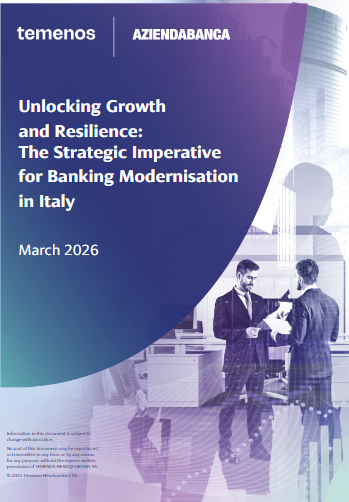
Unlocking Growth and Resilience

The Strategic Imperative for Banking Modernisation in Italy

Download White Paper

Temenos and Azienda Banca – Italy, conducted a research in collaboration with 11 leading Italian banks. The research reveals a sector facing multifaceted and mounting challenges. From external market forces redefining the financial services ecosystem to legacy systems’ limitations, banks must adapt to new realities with greater agility and flexibility than ever before. That’s not easy. In 2026, the Italian banking sector will continue to serve as a pillar of the national economy, supported by Intesa Sanpaolo, UniCredit and other large banks. A vast network of small and medium-sized financial institutions along with regional, cooperative and savings banks will also contribute to productivity. This sound structural mix has historically supported financial inclusion across the country, but operational and technological challenges will continue to arrive in growing numbers for those who do not modernise. Factor in the rise of agentic AI and other emerging technologies, hesitation to innovate can lead to lost customers to traditional competitors and native challengers.

Key topics to discover:

img
  • The Italian Banking Landscape – A Strong Market Under Pressure
  • Italian Banks at a Crossroads: Navigating Complexity in a Changing Financial Landscape
  • Italian banking market – shift in priority
  • Realizing the Business Value of Core Banking Modernisation

Download the excerpt

img

The Path to Intelligent Banking in ASEAN

Discover how ASEAN banks can modernize their core, unify fragmented data, and embed AI across their operations to drive growth, resilience, and financial inclusion.

Download whitepaper
reading

Southeast Asia’s banking sector is at an inflection point. With mobile penetration soaring, super apps normalizing embedded finance, and 70% of the population still underbanked, the opportunity for intelligent banking has never been greater. But so are the barriers.

Legacy infrastructure constrains 90-95% of ASEAN banks. Fragmented data limits AI potential. Regulatory complexity varies country by country. The banks that will lead the next decade are those that modernize now, intelligently, incrementally, and without disrupting what works.

This whitepaper from Temenos, Red Hat, and Systems Limited maps the path forward.

What you’ll learn:

  • Why core banking modernization is the foundation, not the destination, of intelligent banking
  • How to unify fragmented data and accelerate your time-to-AI
  • The architecture enabling ASEAN banks to run securely across hybrid and multi-cloud environments
  • How AI is being embedded into loan origination, fraud detection, and customer engagement today
  • How VP Bank modernized its core, cut overnight processing time by 40%, and became Vietnam’s #1 ranked mobile banking app
wp

Download whitepaper

A strategic guide for ASEAN banking leaders ready to move from AI experimentation to enterprise-wide transformation.

Accelerating Digitization in Credit Unions for a Gen Z Future

Discover how banks and credit unions can accelerate digitization and deliver seamless, Gen Z-ready digital experiences that drive growth and loyalty.

credit union

Gen Z expects fast, intuitive, fully digital banking. For credit unions to stay competitive, accelerating digitization is essential. This whitepaper outlines challenges and opportunities in modernizing operations and shows how to create seamless, personalized member journeys that build loyalty and trust.

Inside, you’ll learn how to eliminate friction in account opening and onboarding, leverage data and automation to personalize experiences, and adopt practical strategies that scale. The paper highlights proven approaches used by leading credit unions and offers an actionable roadmap to future-proof your member experience.

Download whitepaper

A practical playbook for credit unions to reduce onboarding friction and deliver the digitalfirst experiences Gen Z expects.

Key Trends in Wealth Management 2025

Download the White Paper

The Intelligent Core: Unlocking Accelerated Innovation in Banking

Why intelligent core, and why now

Banking is entering a new phase of transformation, one defined not by infrastructure, but by intelligence.

For years, banks have focused on modernizing their core systems to enable faster change, increase resiliency, and improve efficiency. What is new is the need to operate these environments with increasing levels of embedded intelligence, where systems do not just execute processes but continuously interpret, decide, and act.

This introduces a more complex challenge: how to innovate at speed while maintaining control over automated behaviors, ensuring governance, transparency, and regulatory compliance as decision-making becomes more distributed across human and machine. And this across the lifecycle of a core banking system, where the context and needs inevitably change over time.  

At the same time, AI is moving rapidly from pilots to enterprise adoption. What began as curious and isolated use cases is now delivering measurable value across operations, decision-making, and customer engagement.

The convergence of these trends is reshaping the role of core banking. While core systems remain the system of record, the core will soon play a vital role as the system of intelligence. It will actively support innovation, simplify execution, and adapt as the business evolves.

Since 2019, Temenos has been at the forefront of AI in banking, helping banks build, manage, and interpret automated decisions. With GenAI now mainstream, new capabilities are emerging that power intelligent banking – embedding intelligence directly into Temenos Core Banking to enhance the platform itself, unlock more value from existing banking systems, and enable banks to deliver better value faster.

This paper outlines why this shift is happening now, what makes AI adoption in core banking fundamentally different, and how banks can move forward with confidence through a progressive approach.

The most significant impact of an intelligent core is its ability to accelerate innovation. By reducing complexity and embedding intelligence into processes, it enables banks to move faster. Ideas can be developed, tested, and deployed with greater speed and confidence. This changes the role of the core banking platform.

As such, core banking and the processes and data it holds can be a significant enabler for AI strategies and overall innovation. That is why Temenos applies these principles across the platform – to enable banks to support experimentation and adaptation to new requirements, helping to deliver banking experiences that are modern, personal and scalable, but also work in the demanding context of banking governance.

Progressive Modernization Starter Guide

Core modernization that stops at technology is just a cosmetic upgrade. Lasting success requires operating models and architecture that simplify change and strengthen competitiveness.


Key Trends in Wealth Management 2025

Download the White Paper

Unlocking Growth and Resilience The Strategic Imperative for Banking Modernisation in Italy Temenos and Azienda Banca – Italy, conducted a research in collaboration with 11 leading Italian banks. The research reveals a sector facing multifaceted and mounting challenges. From external market forces redefining the financial services ecosystem to legacy systems’ limitations, banks must adapt to new realities with greater agility and flexibility than ever before. That’s not easy. In 2026, the Italian banking sector will continue to serve as a pillar of the national economy, supported by Intesa Sanpaolo, UniCredit and other large banks. A vast network of small and medium-sized financial institutions along with regional, cooperative and savings banks will also contribute to productivity. This sound structural mix has historically supported financial inclusion across the country, but operational and technological challenges will continue to arrive in growing numbers for those who do not modernise. Factor in the rise of agentic AI and other emerging technologies, hesitation to innovate can lead to lost customers to traditional competitors and native challengers. Download White Paper Key topics to discover: Key topics to discover: The Italian Banking Landscape – A Strong Market Under Pressure Italian Banks at a Crossroads: Navigating Complexity in a Changing Financial Landscape Italian banking market – shift in priority Realizing the Business Value of Core Banking Modernisation img Temenos and Azienda Banca – Italy, conducted a research in collaboration with 11 leading Italian banks. The research reveals a sector facing multifaceted and mounting challenges. From external market forces redefining the financial services ecosystem to legacy systems’ limitations, banks must adapt to new realities with greater agility and flexibility than ever before. That’s not easy. In 2026, the Italian banking sector will continue to serve as a pillar of the national economy, supported by Intesa Sanpaolo, UniCredit and other large banks. A vast network of small and medium-sized financial institutions along with regional, cooperative and savings banks will also contribute to productivity. This sound structural mix has historically supported financial inclusion across the country, but operational and technological challenges will continue to arrive in growing numbers for those who do not modernise. Factor in the rise of agentic AI and other emerging technologies, hesitation to innovate can lead to lost customers to traditional competitors and native challengers. img Download the excerpt img img This sound structural mix has historically supported financial inclusion across the country, but operational and technological challenges will continue to arrive in growing numbers for those who do not modernise. Factor in the rise of agentic AI and other emerging technologies, hesitation to innovate can lead to lost customers to traditional competitors and native challengers. img Download the excerpt img img The Italian Banking Landscape – A Strong Market Under Pressure Italian Banks at a Crossroads: Navigating Complexity in a Changing Financial Landscape Italian banking market – shift in priority Realizing the Business Value of Core Banking Modernisation

Key Trends in Wealth Management 2025

Download the White Paper

The Path to Intelligent Banking in ASEAN Discover how ASEAN banks can modernize their core, unify fragmented data, and embed AI across their operations to drive growth, resilience, and financial inclusion. reading Southeast Asia’s banking sector is at an inflection point. With mobile penetration soaring, super apps normalizing embedded finance, and 70% of the population still underbanked, the opportunity for intelligent banking has never been greater. But so are the barriers. Legacy infrastructure constrains 90-95% of ASEAN banks. Fragmented data limits AI potential. Regulatory complexity varies country by country. The banks that will lead the next decade are those that modernize now, intelligently, incrementally, and without disrupting what works. This whitepaper from Temenos, Red Hat, and Systems Limited maps the path forward. What you’ll learn: Why core banking modernization is the foundation, not the destination, of intelligent banking How to unify fragmented data and accelerate your time-to-AI The architecture enabling ASEAN banks to run securely across hybrid and multi-cloud environments How AI is being embedded into loan origination, fraud detection, and customer engagement today How VP Bank modernized its core, cut overnight processing time by 40%, and became Vietnam’s #1 ranked mobile banking app wp Download whitepaper A strategic guide for ASEAN banking leaders ready to move from AI experimentation to enterprise-wide transformation. Download whitepaper

Key Trends in Wealth Management 2025

Download the White Paper

Accelerating Digitization in Credit Unions for a Gen Z Future Discover how banks and credit unions can accelerate digitization and deliver seamless, Gen Z-ready digital experiences that drive growth and loyalty. credit union Gen Z expects fast, intuitive, fully digital banking. For credit unions to stay competitive, accelerating digitization is essential. This whitepaper outlines challenges and opportunities in modernizing operations and shows how to create seamless, personalized member journeys that build loyalty and trust. Inside, you’ll learn how to eliminate friction in account opening and onboarding, leverage data and automation to personalize experiences, and adopt practical strategies that scale. The paper highlights proven approaches used by leading credit unions and offers an actionable roadmap to future-proof your member experience. Download whitepaper A practical playbook for credit unions to reduce onboarding friction and deliver the digital-first experiences Gen Z expects. Gen Z expects fast, intuitive, fully digital banking. For credit unions to stay competitive, accelerating digitization is essential. This whitepaper outlines challenges and opportunities in modernizing operations and shows how to create seamless, personalized member journeys that build loyalty and trust. Inside, you’ll learn how to eliminate friction in account opening and onboarding, leverage data and automation to personalize experiences, and adopt practical strategies that scale. The paper highlights proven approaches used by leading credit unions and offers an actionable roadmap to future-proof your member experience.

Key Trends in Wealth Management 2025

Download the White Paper

As the wealth management industry evolves, 2025 is poised to be a transformative year, driven by technological innovation, shifting client expectations, and global economic dynamics. Eric Mellor, Wealth Management Specialist at Temenos explores the six key trends impacting the wealth management sector in 2025, and how an ability to blend cutting-edge technology with a human touch to meet the evolving needs of a diverse client base continues to be the key to unlocking the potential for this sector.


Download the White Paper


Key Trends in Wealth Management 2025

Download the White Paper

The challengers are all customer-centric, leveraging disruptive technologies such as AI to develop compelling customer experiences. But how do they navigate through…

  • Profitability barriers?
  • The uncertain path for growth?
  • Rising interest rate and recessionary environment?

About the Author

Kanika Hope is the Chief Strategy Officer, leading Temenos’ global business strategy with responsibility for market intelligence, strategic sales support and value-based selling. Kanika joined Temenos in 2015 as Global Strategic Business Development Director and she laid the foundation of value selling in Temenos. She established the renowned Temenos Value Benchmark program and an influential series of thought leadership insights on strategic banking issues and trends.

Kanika has nearly 30 years experience in banking technology and operations and has held senior roles within SAP, McKinsey and General Electric. Kanika holds an MBA from the Indian Institute of Management, Bangalore.


450

challenger banks globally

$300B

worth in 2022 compared to $161B in 2017

up to

75%

lower operational cost from fully operating digitally

Can disruptive technologies bolster the competitiveness of North American Banks?

North American banks are turning to new technologies, to modernize and secure their core infrastructure and processes, while competing with non-traditional players. Download the new report from the Economist, commissioned by Temenos.

View More

Key Trends in Wealth Management 2025

Download the White Paper
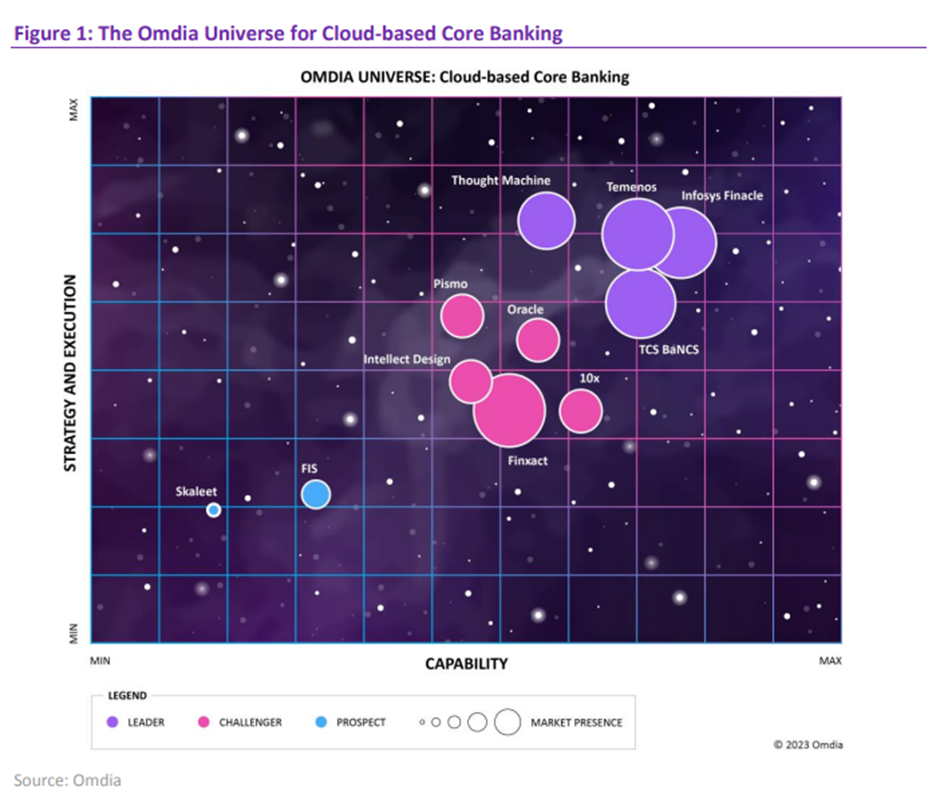
  • Omdia recognized that Temenos was a high performer across the board and achieved the highest scores overall for market alignment and innovation, in addition to performing strongly for Temenos Banking Cloud’s broader platform capabilities.
  • Omdia highlights the strength of the Temenos solution which offers innovation in the areas of open products for the creation of highly configurable financial products (i.e., smart products), AI and ESG.
  • Other strengths referenced by Omdia include Temenos’ (X)AI-enabled analytics which are embedded throughout the platform.

According to Philip Benton, Senior Analyst, Omdia:

“Temenos should appear on your shortlist, particularly if you are seeking a platform that enables rapid new product launches and innovation.”

Download the report to learn more about why Omdia recognizes Temenos as a leader among Cloud-based Core Banking providers.


Key Trends in Wealth Management 2025

Download the White Paper

The complexity of products, processes and transactions in corporate banking has so far resulted in relatively lower levels of digitization compared to retail. Yet business owners increasingly expect simple, holistic processes and a seamless customer experience.

Open banking provides a unique opportunity for banks to meet this need, by enabling increased automation and personalization of services for business customers. At the same time, it enables banks to move beyond traditional banking activities and open up new revenue streams through Banking-as-a-Service (BaaS).


Find out more about the opportunities in open banking for corporates and SMEs in this whitepaper.

About the Author

Kanika Hope is the Chief Strategy Officer, leading Temenos’ global business strategy with responsibility for market intelligence, strategic sales support and value-based selling. Kanika joined Temenos in 2015 as Global Strategic Business Development Director and she laid the foundation of value selling in Temenos. She established the renowned Temenos Value Benchmark program and an influential series of thought leadership insights on strategic banking issues and trends.

Kanika has nearly 30 years experience in banking technology and operations and has held senior roles within SAP, McKinsey and General Electric. Kanika holds an MBA from the Indian Institute of Management, Bangalore.


Download the whitepaper today to find out more:


Key Trends in Wealth Management 2025

Download the White Paper

Cloud technology has matured

72% of banking executives now recognize that incorporating cloud into their overall growth strategy will help them achieve their objectives faster and with confidence. Turning that belief into reality needs strategy, planning, and extensible architecture together with uncompromising security and industrial-grade resilience. The Temenos Banking Cloud powered by Amazon Web Services (AWS) brings all of this and more.

Download White Paper


Key Trends in Wealth Management 2025

Download the White Paper

The payments world is changing at pace. US-based market research company IDC forecasts that 74% of consumer payments will be handled by non-traditional financial institutions by 2030. Customers now expect seamless, real-time and secure payment experiences, while regulation is also playing its part, with open banking and domestic real time payments schemes such as FedNow.

With payments modernization therefore a top priority for US banks, this survey of 2000 American adults provides valuable insights on the payment choices and expectations of consumers, and with it the opportunities for US banks to enhance their competitive position and improve customer satisfaction.

Download the whitepaper to find out:

Payments: supporting the needs of the banking industry

· The top payment methods for US consumers today

· How payment methods will change in the next three years

· Which factors most influence payment choices

· Why instant payments offer a unique opportunity for banks

Meet the Expert

Patrick Devlin has over 20 years of experience in global payment processing, alternative & real time payments and digital goods, but also pre-paid, debit, and credit card issuing program and partnership management. He has an extensive knowledge of integrated Fintech partnerships and execution as well as e-commerce payment optimization. Patrick has worked in marketing leadership and financial services roles at JP Morgan Chase, HSBC, American Express, Visa, PayPal and WorldPay. Patrick currently serves as Senior Vice President – Payments at Temenos.

Patrick and other payments experts from Temenos will be at Sibos in Toronto, September 18-21. To find out more or book a meeting, click here.

Download Whitepaper