Banks increasingly want to modernize progressively, introducing composable capabilities and AI alongside proven core banking services without compromising performance, scalability or resilience. The 2026 Temenos Performance Benchmark puts this model to the test.
Discover how the benchmark demonstrates:
Progressive modernization in practice, demonstrating that integrated core banking, composable capabilities and AI-enabled workloads can operate at scale.
Cloud-native modernization at scale, with Temenos SaaS on Microsoft Azure supporting the benchmark environment to deliver 16,385 TPS.
Independent scalability of banking capabilities, while maintaining performance, resilience and integration across the wider banking platform.
Discover how our platform helps financial institutions navigate change, embrace new opportunities, and deliver smarter, faster banking. Together, we embrace the future of finance – Leading Banking Forward.
Product Innovation with Digital Core Modernization
While many banks have started down the path of digital transformation, only a very few established large banks have fully completed the transition from legacy systems and manual-driven processes to becoming truly customer-centric, data-led, agile digital banks.
Komerční Banka (KB), which is part of Société Générale, is one of them.
By modernizing from a legacy mainframe system to a real-time, cloud-native core, KB has created a new, fully digitalized platform and successfully migrated more than 1.3 million customers.
This transformation has enabled the bank to deliver a fully digital proposition, strengthen digital sales, improve customer satisfaction, and create a scalable platform for future growth.
Alongside this, KB has delivered market-leading product innovation, including a market-leading multi-currency account that has become a core part of its retail customer proposition.
Download the case study
The future of banking starts here
Discover how our platform helps financial institutions navigate change, embrace new opportunities, and deliver smarter, faster banking. Together, we embrace the future of finance – Leading Banking Forward.
Banks today face mounting pressures: rising customer expectations, regulatory scrutiny, increasing cyber threats, and the relentless pace of innovation. The institutions pulling ahead are those that treat technology as a strategic asset, not an operational burden.
This report helps banking leaders understand:
The technology trends delivering the greatest impact across segments
How generative and agentic AI are transforming productivity, workflows, and customer outcomes
Why modern, cloud‑native, composable platforms are now essential foundations for growth
How leaders are increasing share of wallet, improving cross-sell, and using real-time, AI-driven capabilities to grow in areas such as DeFi and Payments
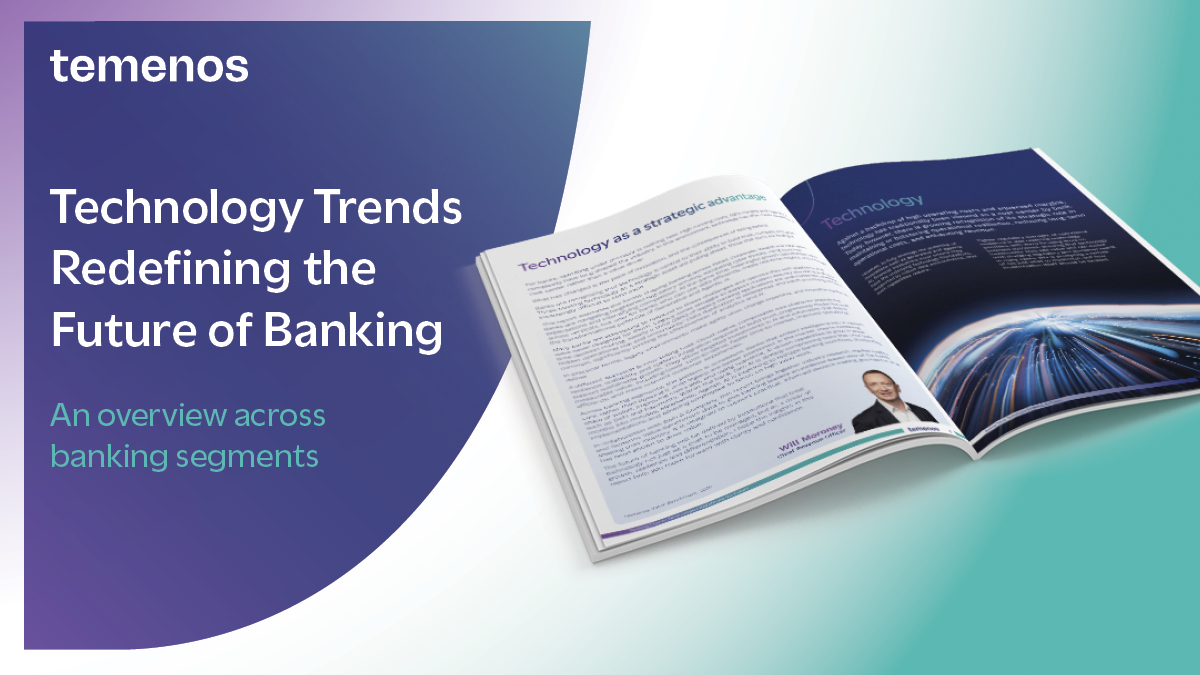
In collaboration with Bain & Company, this report brings together industry research, market insights and Temenos Value Benchmark data to give banking leaders an evidence-based view of the trends shaping their banking segments, across technology, retail and business banking, corporate and commercial banking, wealth management and payments. It is designed to support practical, informed decision‑making, grounded in what has been shown to drive value.
Technology Trends Redefining Banking An overview across banking segments Banks today face mounting pressures: rising customer expectations, regulatory scrutiny, increasing cyber threats, and the relentless pace of innovation. The institutions pulling ahead are those that treat technology as a strategic asset, not an operational burden. Trends report This report helps banking leaders understand: The technology trends delivering the greatest impact across segments How generative and agentic AI are transforming productivity, workflows, and customer outcomes Why modern, cloud‑native, composable platforms are now essential foundations for growth How leaders are increasing share of wallet, improving cross-sell, and using real-time, AI-driven capabilities to grow in areas such as DeFi and Payments In collaboration with Bain & Company, this report brings together industry research, market insights and Temenos Value Benchmark data to give banking leaders an evidence-based view of the trends shaping their banking segments, across technology, retail and business banking, corporate and commercial banking, wealth management and payments. It is designed to support practical, informed decision‑making, grounded in what has been shown to drive value. Download the full report Access the immersive experience Explore segment trends Lights moving fast over world Technology Technology Trends Woman holding tablet tapping with hands and with headphones around neck Retail & Business Banking Retail & Business Trends Cement building with sharp angles in photo. This features a corner of one of those building. Corporate & Commercial Banking Corporate & Commercial Trends Woman holding tablet while figures are projected onto a clear screen in front of her. Wealth Management Wealth Management Trends Person holding phone to tap for payment Payments Payments Trends Temenos | Bain & Company logo Meet the Experts Meet the Experts
The future of banking starts here
Discover how our platform helps financial institutions navigate change, embrace new opportunities, and deliver smarter, faster banking. Together, we embrace the future of finance – Leading Banking Forward.
Banks need systems that are fast, secure, scalable and AI driven, as well as sustainable. Check out our latest report with Microsoft, where we put the Temenos Banking Platform to the test again.
Elastic scalability for core banking goes beyond maximizing performance. To help banks meet the growing importance of carbon-conscious computing in banking, the Temenos Performance Benchmark 2025 provides insight into how high transaction performance can be delivered with a reduced carbon footprint.
As banks increasingly adopt AI for financial crime mitigation, application development, and operational efficiency, we’ve also integrated AI workloads into the 2025 benchmark. This allows us to test scalability and performance, helping banks understand the infrastructure and capabilities needed to run these advanced applications reliably and efficiently in real-world environments.
Each year, Temenos conducts a production-grade simulation in collaboration with key partners to validate the latest release of the Temenos Banking Platform in a real-world, production-like environment (see 2024 benchmark). This rigorous test pushes the boundaries of elasticity, transaction throughput, response times, efficiency, and sustainability.
What you’ll discover
Delivering significant efficiency and decarbonization, we achieved a notable 17,000+ transactions per second (TPS).
As banks increasingly adopt AI for financial crime mitigation, we integrated AI workloads into the 2025 benchmark.
How we have enhanced performance through more efficient code and the use of Azure ARM Cobalt chipsets.
Essential insights into how banks can meet evolving sustainability standards and advance their ESG commitments.
In 2011, Temenos and Microsoft were the first in the industry to bring core banking to the cloud. Today, the partnership supports financial institutions that leverage the cloud around the world. The combination of Temenos SaaS and the Azure Cloud Platform enables banks to leverage modern and trusted cloud technology that can live up to specific requirements across regions, including data regulation, security, and compliance.
Explore the results and take the next step toward the future of banking.
Discover how a faster, more secure, scalable, AI-driven, and sustainable banking platform can transform your financial institution.
Performance Benchmark Report 2025 Banks need systems that are fast, secure, scalable and AI driven, as well as sustainable. Check out our latest report with Microsoft, where we put the Temenos Banking Platform to the test again. Download report Elastic scalability for core banking goes beyond maximizing performance; to help banks meet the growing importance of carbon-conscious computing in banking, the Temenos Performance Benchmark 2025 provides insight into how high transaction performance can be delivered. Elastic scalability for core banking goes beyond maximizing performance. To help banks meet the growing importance of carbon-conscious computing in banking, the Temenos Performance Benchmark 2025 provides insight into how high transaction performance can be delivered with a reduced carbon footprint. As banks increasingly adopt AI for financial crime mitigation, application development, and operational efficiency, we’ve also integrated AI workloads into the 2025 benchmark. This allows us to test scalability and performance, helping banks understand the infrastructure and capabilities needed to run these advanced applications reliably and efficiently in real-world environments. Each year, Temenos conducts a production-grade simulation in collaboration with key partners to validate the latest release of the Temenos Banking Platform in a real-world, production-like environment (see 2024 benchmark). This rigorous test pushes the boundaries of elasticity, transaction throughput, response times, efficiency, and sustainability. What you’ll discover Benchmark Partner Microsoft Azure In 2011, Temenos and Microsoft were the first in the industry to bring core banking to the cloud. Today, the partnership supports financial institutions that leverage the cloud around the world. The combination of Temenos SaaS and the Azure Cloud Platform enables banks to leverage modern and trusted cloud technology that can live up to specific requirements across regions, including data regulation, security, and compliance. Elastic scalability for core banking goes beyond maximizing performance; to help banks meet the growing importance of carbon-conscious computing in banking, the Temenos Performance Benchmark 2025 provides insight into how high transaction performance can be delivered As banks increasingly adopt AI for financial crime mitigation, application development, and operational efficiency, we’ve also integrated AI workloads into the 2025 benchmark. This allows us to test scalability and performance, helping banks understand the infrastructure and capabilities needed to run these advanced applications reliably and efficiently in real-world environments. Each year, Temenos conducts a production-grade simulation in collaboration with key partners to validate the latest release of the Temenos Banking Platform in a real-world, production-like environment. This rigorous test pushes the boundaries of elasticity, transaction throughput, response times, efficiency, and sustainability Delivering significant efficiency and decarbonization, achieving a notable 17,000+ transactions per second (TPS). As banks increasingly adopt AI for financial crime mitigation we’ve integrated AI workloads into the 2025 benchmark. How we have enhanced performance through more efficient code and the use of Azure ARM Cobalt chipsets. Essential insights into how banks can meet evolving sustainability standards and advance their ESG commitments. Explore the results and take the next step toward the future of banking. Discover how a faster, more secure, scalable, AI-driven, and sustainable banking platform can transform your financial institution. Microsoft Azure In 2011, Temenos and Microsoft were the first in the industry to bring core banking to the cloud. Today, the partnership supports financial institutions that leverage the cloud around the world. The combination of Temenos SaaS and the Azure Cloud Platform enables banks to leverage modern and trusted cloud technology that can live up to specific requirements across regions, including data regulation, security, and compliance. Learn more about Temenos Technology Explore our technology Learn how we empower our clients to benefit from continuous innovation, driven by our market-leading R&D investment in our single code base. Download report https://vimeo.com/1117818425/70ea20d65e https://vimeo.com/1117818425/70ea20d65e i1 Delivering significant efficiency and decarbonization, we achieved a notable 17,000+ transactions per second (TPS). i2 As banks increasingly adopt AI for financial crime mitigation, we integrated AI workloads into the 2025 benchmark. i3 How we have enhanced performance through more efficient code and the use of Azure ARM Cobalt chipsets. i4 Essential insights into how banks can meet evolving sustainability standards and advance their ESG commitments. Download report Benchmark partner Temenos logo ft Microsoft Microsoft Azure In 2011, Temenos and Microsoft were the first in the industry to bring core banking to the cloud. Today, the partnership supports financial institutions that leverage the cloud around the world. The combination of Temenos SaaS and the Azure Cloud Platform enables banks to leverage modern and trusted cloud technology that can live up to specific requirements across regions, including data regulation, security, and compliance. Explore the results and take the next step toward the future of banking. Discover how a faster, more secure, scalable, AI-driven, and sustainable banking platform can transform your financial institution. Explore our technology https://vimeo.com/1117818425/70ea20d65e benchmark 2025 Delivering significant efficiency and decarbonization, achieving a notable 17,000+ transactions per second (TPS). As banks increasingly adopt AI for financial crime mitigation we’ve integrated AI workloads into the 2025 benchmark. How we have enhanced performance through more efficient code and the use of Azure ARM Cobalt chipsets. Essential insights into how banks can meet evolving sustainability standards and advance their ESG commitments. Download report https://vimeo.com/1117818425/70ea20d65e Each year, Temenos conducts a production-grade simulation in collaboration with key partners to validate the latest release of the Temenos Banking Platform in a real-world, production-like environment. This rigorous test pushes the boundaries of elasticity, transaction throughput, response times, efficiency, and sustainability Explore our technology ai footprint Temenos Sustainability Benchmark Report 2024 The 2024 benchmark is centered on delivering significant efficiency and decarbonization, achieving a notable 15,000 transactions per second (TPS). Download report
The future of banking starts here
Discover how our platform helps financial institutions navigate change, embrace new opportunities, and deliver smarter, faster banking. Together, we embrace the future of finance – Leading Banking Forward.
IBSi SLT: Temenos #1 for Core Banking for 20 years
Temenos has been recognized as the #1 best-selling software provider in 13 categories in the IBSi Sales League Table 2025, being named #1 for Core Banking for the 20th consecutive year.
The IBS Intelligence Annual Sales League
An annual benchmarking exercise, which has been running for over 24 years and is based on the number of new customer contracts signed in a calendar year. The SLT is recognized as the barometer for financial technology providers’ sales performance across the banking industry.
In 2025, Temenos ranked #1 in the following categories:
Universal Banking – Core
Digital Banking and Channels
Payments – Retail
Private Banking and Wealth Management
Risk Management
Treasury and Risk Management
Digital Only Banks
Datawarehouse & BI
Islamic Banking – Universal Banking – Core
Islamic Banking – Risk Management
Islamic Banking – Payments – Retail
Islamic Banking – Wholesale Banking Treasury
Islamic Banking – Digital Banking and Channels
Download report:
The future of banking starts here
Discover how our platform helps financial institutions navigate change, embrace new opportunities, and deliver smarter, faster banking. Together, we embrace the future of finance – Leading Banking Forward.
Who Needs Silicon Valley? China Leads Asia’s Diverse Digital Banking Markets
If you want to see what universal digital banking looks like, skip Silicon Valley or London’s fintech hubs. China’s Alipay and WeChat Pay show how to do smart, mobile-based banking on a massive scale. Regulators are now adapting to new customer demands.
Banks increasingly want to modernize progressively, introducing composable capabilities and AI alongside proven core banking services without compromising performance, scalability or resilience. The 2026 Temenos Performance Benchmark puts this model to the test.
Discover how the benchmark demonstrates:
Progressive modernization in practice, demonstrating that integrated core banking, composable capabilities and AI-enabled workloads can operate at scale.
Cloud-native modernization at scale, with Temenos SaaS on Microsoft Azure supporting the benchmark environment to deliver 16,385 TPS.
Independent scalability of banking capabilities, while maintaining performance, resilience and integration across the wider banking platform.
Who Needs Silicon Valley? China Leads Asia’s Diverse Digital Banking Markets
If you want to see what universal digital banking looks like, skip Silicon Valley or London’s fintech hubs. China’s Alipay and WeChat Pay show how to do smart, mobile-based banking on a massive scale. Regulators are now adapting to new customer demands.
Product Innovation with Digital Core Modernization
While many banks have started down the path of digital transformation, only a very few established large banks have fully completed the transition from legacy systems and manual-driven processes to becoming truly customer-centric, data-led, agile digital banks.
Komerční Banka (KB), which is part of Société Générale, is one of them.
By modernizing from a legacy mainframe system to a real-time, cloud-native core, KB has created a new, fully digitalized platform and successfully migrated more than 1.3 million customers.
This transformation has enabled the bank to deliver a fully digital proposition, strengthen digital sales, improve customer satisfaction, and create a scalable platform for future growth.
Alongside this, KB has delivered market-leading product innovation, including a market-leading multi-currency account that has become a core part of its retail customer proposition.
Who Needs Silicon Valley? China Leads Asia’s Diverse Digital Banking Markets
If you want to see what universal digital banking looks like, skip Silicon Valley or London’s fintech hubs. China’s Alipay and WeChat Pay show how to do smart, mobile-based banking on a massive scale. Regulators are now adapting to new customer demands.
Banks today face mounting pressures: rising customer expectations, regulatory scrutiny, increasing cyber threats, and the relentless pace of innovation. The institutions pulling ahead are those that treat technology as a strategic asset, not an operational burden.
This report helps banking leaders understand:
The technology trends delivering the greatest impact across segments
How generative and agentic AI are transforming productivity, workflows, and customer outcomes
Why modern, cloud‑native, composable platforms are now essential foundations for growth
How leaders are increasing share of wallet, improving cross-sell, and using real-time, AI-driven capabilities to grow in areas such as DeFi and Payments
In collaboration with Bain & Company, this report brings together industry research, market insights and Temenos Value Benchmark data to give banking leaders an evidence-based view of the trends shaping their banking segments, across technology, retail and business banking, corporate and commercial banking, wealth management and payments. It is designed to support practical, informed decision‑making, grounded in what has been shown to drive value.
Technology Trends Redefining Banking An overview across banking segments Banks today face mounting pressures: rising customer expectations, regulatory scrutiny, increasing cyber threats, and the relentless pace of innovation. The institutions pulling ahead are those that treat technology as a strategic asset, not an operational burden. Trends report This report helps banking leaders understand: The technology trends delivering the greatest impact across segments How generative and agentic AI are transforming productivity, workflows, and customer outcomes Why modern, cloud‑native, composable platforms are now essential foundations for growth How leaders are increasing share of wallet, improving cross-sell, and using real-time, AI-driven capabilities to grow in areas such as DeFi and Payments In collaboration with Bain & Company, this report brings together industry research, market insights and Temenos Value Benchmark data to give banking leaders an evidence-based view of the trends shaping their banking segments, across technology, retail and business banking, corporate and commercial banking, wealth management and payments. It is designed to support practical, informed decision‑making, grounded in what has been shown to drive value. Download the full report Access the immersive experience Explore segment trends Lights moving fast over world Technology Technology Trends Woman holding tablet tapping with hands and with headphones around neck Retail & Business Banking Retail & Business Trends Cement building with sharp angles in photo. This features a corner of one of those building. Corporate & Commercial Banking Corporate & Commercial Trends Woman holding tablet while figures are projected onto a clear screen in front of her. Wealth Management Wealth Management Trends Person holding phone to tap for payment Payments Payments Trends Temenos | Bain & Company logo Meet the Experts Meet the Experts
Who Needs Silicon Valley? China Leads Asia’s Diverse Digital Banking Markets
If you want to see what universal digital banking looks like, skip Silicon Valley or London’s fintech hubs. China’s Alipay and WeChat Pay show how to do smart, mobile-based banking on a massive scale. Regulators are now adapting to new customer demands.
Banks need systems that are fast, secure, scalable and AI driven, as well as sustainable. Check out our latest report with Microsoft, where we put the Temenos Banking Platform to the test again.
Elastic scalability for core banking goes beyond maximizing performance. To help banks meet the growing importance of carbon-conscious computing in banking, the Temenos Performance Benchmark 2025 provides insight into how high transaction performance can be delivered with a reduced carbon footprint.
As banks increasingly adopt AI for financial crime mitigation, application development, and operational efficiency, we’ve also integrated AI workloads into the 2025 benchmark. This allows us to test scalability and performance, helping banks understand the infrastructure and capabilities needed to run these advanced applications reliably and efficiently in real-world environments.
Each year, Temenos conducts a production-grade simulation in collaboration with key partners to validate the latest release of the Temenos Banking Platform in a real-world, production-like environment (see 2024 benchmark). This rigorous test pushes the boundaries of elasticity, transaction throughput, response times, efficiency, and sustainability.
What you’ll discover
Delivering significant efficiency and decarbonization, we achieved a notable 17,000+ transactions per second (TPS).
As banks increasingly adopt AI for financial crime mitigation, we integrated AI workloads into the 2025 benchmark.
How we have enhanced performance through more efficient code and the use of Azure ARM Cobalt chipsets.
Essential insights into how banks can meet evolving sustainability standards and advance their ESG commitments.
In 2011, Temenos and Microsoft were the first in the industry to bring core banking to the cloud. Today, the partnership supports financial institutions that leverage the cloud around the world. The combination of Temenos SaaS and the Azure Cloud Platform enables banks to leverage modern and trusted cloud technology that can live up to specific requirements across regions, including data regulation, security, and compliance.
Explore the results and take the next step toward the future of banking.
Discover how a faster, more secure, scalable, AI-driven, and sustainable banking platform can transform your financial institution.
Performance Benchmark Report 2025 Banks need systems that are fast, secure, scalable and AI driven, as well as sustainable. Check out our latest report with Microsoft, where we put the Temenos Banking Platform to the test again. Download report Elastic scalability for core banking goes beyond maximizing performance; to help banks meet the growing importance of carbon-conscious computing in banking, the Temenos Performance Benchmark 2025 provides insight into how high transaction performance can be delivered. Elastic scalability for core banking goes beyond maximizing performance. To help banks meet the growing importance of carbon-conscious computing in banking, the Temenos Performance Benchmark 2025 provides insight into how high transaction performance can be delivered with a reduced carbon footprint. As banks increasingly adopt AI for financial crime mitigation, application development, and operational efficiency, we’ve also integrated AI workloads into the 2025 benchmark. This allows us to test scalability and performance, helping banks understand the infrastructure and capabilities needed to run these advanced applications reliably and efficiently in real-world environments. Each year, Temenos conducts a production-grade simulation in collaboration with key partners to validate the latest release of the Temenos Banking Platform in a real-world, production-like environment (see 2024 benchmark). This rigorous test pushes the boundaries of elasticity, transaction throughput, response times, efficiency, and sustainability. What you’ll discover Benchmark Partner Microsoft Azure In 2011, Temenos and Microsoft were the first in the industry to bring core banking to the cloud. Today, the partnership supports financial institutions that leverage the cloud around the world. The combination of Temenos SaaS and the Azure Cloud Platform enables banks to leverage modern and trusted cloud technology that can live up to specific requirements across regions, including data regulation, security, and compliance. Elastic scalability for core banking goes beyond maximizing performance; to help banks meet the growing importance of carbon-conscious computing in banking, the Temenos Performance Benchmark 2025 provides insight into how high transaction performance can be delivered As banks increasingly adopt AI for financial crime mitigation, application development, and operational efficiency, we’ve also integrated AI workloads into the 2025 benchmark. This allows us to test scalability and performance, helping banks understand the infrastructure and capabilities needed to run these advanced applications reliably and efficiently in real-world environments. Each year, Temenos conducts a production-grade simulation in collaboration with key partners to validate the latest release of the Temenos Banking Platform in a real-world, production-like environment. This rigorous test pushes the boundaries of elasticity, transaction throughput, response times, efficiency, and sustainability Delivering significant efficiency and decarbonization, achieving a notable 17,000+ transactions per second (TPS). As banks increasingly adopt AI for financial crime mitigation we’ve integrated AI workloads into the 2025 benchmark. How we have enhanced performance through more efficient code and the use of Azure ARM Cobalt chipsets. Essential insights into how banks can meet evolving sustainability standards and advance their ESG commitments. Explore the results and take the next step toward the future of banking. Discover how a faster, more secure, scalable, AI-driven, and sustainable banking platform can transform your financial institution. Microsoft Azure In 2011, Temenos and Microsoft were the first in the industry to bring core banking to the cloud. Today, the partnership supports financial institutions that leverage the cloud around the world. The combination of Temenos SaaS and the Azure Cloud Platform enables banks to leverage modern and trusted cloud technology that can live up to specific requirements across regions, including data regulation, security, and compliance. Learn more about Temenos Technology Explore our technology Learn how we empower our clients to benefit from continuous innovation, driven by our market-leading R&D investment in our single code base. Download report https://vimeo.com/1117818425/70ea20d65e https://vimeo.com/1117818425/70ea20d65e i1 Delivering significant efficiency and decarbonization, we achieved a notable 17,000+ transactions per second (TPS). i2 As banks increasingly adopt AI for financial crime mitigation, we integrated AI workloads into the 2025 benchmark. i3 How we have enhanced performance through more efficient code and the use of Azure ARM Cobalt chipsets. i4 Essential insights into how banks can meet evolving sustainability standards and advance their ESG commitments. Download report Benchmark partner Temenos logo ft Microsoft Microsoft Azure In 2011, Temenos and Microsoft were the first in the industry to bring core banking to the cloud. Today, the partnership supports financial institutions that leverage the cloud around the world. The combination of Temenos SaaS and the Azure Cloud Platform enables banks to leverage modern and trusted cloud technology that can live up to specific requirements across regions, including data regulation, security, and compliance. Explore the results and take the next step toward the future of banking. Discover how a faster, more secure, scalable, AI-driven, and sustainable banking platform can transform your financial institution. Explore our technology https://vimeo.com/1117818425/70ea20d65e benchmark 2025 Delivering significant efficiency and decarbonization, achieving a notable 17,000+ transactions per second (TPS). As banks increasingly adopt AI for financial crime mitigation we’ve integrated AI workloads into the 2025 benchmark. How we have enhanced performance through more efficient code and the use of Azure ARM Cobalt chipsets. Essential insights into how banks can meet evolving sustainability standards and advance their ESG commitments. Download report https://vimeo.com/1117818425/70ea20d65e Each year, Temenos conducts a production-grade simulation in collaboration with key partners to validate the latest release of the Temenos Banking Platform in a real-world, production-like environment. This rigorous test pushes the boundaries of elasticity, transaction throughput, response times, efficiency, and sustainability Explore our technology ai footprint Temenos Sustainability Benchmark Report 2024 The 2024 benchmark is centered on delivering significant efficiency and decarbonization, achieving a notable 15,000 transactions per second (TPS). Download report
Who Needs Silicon Valley? China Leads Asia’s Diverse Digital Banking Markets
If you want to see what universal digital banking looks like, skip Silicon Valley or London’s fintech hubs. China’s Alipay and WeChat Pay show how to do smart, mobile-based banking on a massive scale. Regulators are now adapting to new customer demands.
IBSi SLT: Temenos #1 for Core Banking for 20 years Temenos has been recognized as the #1 best-selling software provider in 13 categories in the IBSi Sales League Table 2025, being named #1 for Core Banking for the 20th consecutive year. The IBS Intelligence Annual Sales League An annual benchmarking exercise, which has been running for over 24 years and is based on the number of new customer contracts signed in a calendar year. The SLT is recognized as the barometer for financial technology providers’ sales performance across the banking industry. In 2025, Temenos ranked #1 in the following categories: Universal Banking – Core Digital Banking and Channels Payments – Retail Private Banking and Wealth Management Risk Management Treasury and Risk Management Digital Only Banks Datawarehouse & BI Islamic Banking – Universal Banking – Core Islamic Banking – Risk Management Islamic Banking – Payments – Retail Islamic Banking – Wholesale Banking Treasury Islamic Banking – Digital Banking and Channels Download report:
Who Needs Silicon Valley? China Leads Asia’s Diverse Digital Banking Markets
If you want to see what universal digital banking looks like, skip Silicon Valley or London’s fintech hubs. China’s Alipay and WeChat Pay show how to do smart, mobile-based banking on a massive scale. Regulators are now adapting to new customer demands.
The Asia-Pacific retail banking market is diverse, reflecting the different levels of social, economic and financial institutional development. It ranges from the near universal coverage found in the more developed markets of Australia, New Zealand, Singapore and Hong Kong to the emerging market of Cambodia, where only 21% of people over the age of 15 have a bank account. It also includes India, where government policies have pushed inclusion by shifting state transfers, pensions and benefits directly into accounts or onto biometric smartcards. Accordingly, Indian account ownership has jumped from 35% in 2011 to 80% today.
However, bankers in The Economist Intelligence Unit’s survey see common themes. Within the Asia-Pacific region, changing customer demand will have the biggest impact on retail banking in the next three years. Regulatory trends are less of a concern in Asia-Pacific (40%), compared to Europe (46%) and North America (56%). Bankers in Hong Kong and Singapore seem to benefit from the more tech-friendly “try it and see” approach of their own regulators. Both the Hong Kong Monetary Authority (HKMA) and the Monetary Authority of Singapore (MAS) have opted to create “regulatory sandboxes” to encourage innovation. These sandboxes allow banks and FinTechs to trial their ideas while involving only a limited number of participating customers. However, the situation is very different in Australia, where bankers have come under fire from the regulator due to poor risk management, high fees and widespread mis-selling.
An April 2018 report by the Australian Prudential Regulation Authority into the Commonwealth Bank of Australia (CBA) made clear that “a widespread sense of complacency has run through CBA, from the top down”.2 The subsequent loss of 20m customer account details only compounded the likelihood of significant reputational damage.
Although Australia has not been Asia-Pacific’s leading example of customer-centric, innovative, fast and frictionless banking to date, this may change with new competition from smaller players. New competition should accelerate the digitalization process that could help restore the reputation of Australia’s bigger banks. The environment will also change with the federal government’s required phased implementation of open banking commencing in July 2019 by the big four: the CBA; the National Australia Bank; the Australia and New Zealand Banking Group; and Westpac.
Who Needs Silicon Valley? China Leads Asia’s Diverse Digital Banking Markets
If you want to see what universal digital banking looks like, skip Silicon Valley or London’s fintech hubs. China’s Alipay and WeChat Pay show how to do smart, mobile-based banking on a massive scale. Regulators are now adapting to new customer demands.
Perhaps nowhere are financial crimes, including fraud, more serious and more pronounced than in the banking sector of the economy. They are one of the biggest single causes of bank failure and distress in the African banking system.
In general, Africa is the most vulnerable and currently the most affected by financial crime in comparison to any other continent. According to PWC’s Global Economic Crime Survey 2016, reported ‘economic’ crime has gone up by 7% in Africa over the last 2 years (to 57% against a global average of 36%). And KPMG’s AML survey1 listed Africa as having the lowest satisfaction rate in terms of its transaction monitoring system. There has therefore never been a more important time to have a full understanding of this issue and review existing systems to ensure the areas most open to abuse are addressed.
Welcome to the Temenos and NetGuardians A-Z of Financial Crime in Africa. A comprehensive e-book outlining the what, why and how of financial crime within the fastest-growing continent. Temenos and NetGuardians have teamed up to compile this indispensable A-Z guide exploring the size of the issue, who commits it and, most importantly, what can be done to mitigate against it. We hope it’s thought-provoking, not too worrying, stimulates discussion, and provides guidance and reassurance for the future.
Who Needs Silicon Valley? China Leads Asia’s Diverse Digital Banking Markets
If you want to see what universal digital banking looks like, skip Silicon Valley or London’s fintech hubs. China’s Alipay and WeChat Pay show how to do smart, mobile-based banking on a massive scale. Regulators are now adapting to new customer demands.
A great transfer in wealth from aging baby boomers to younger generations is under way, and it is reshaping the industry in ways that demand greater efficiency and adaptation byincumbent firms. The challenge: retain the loyalty of customers with changing demands in a world of greater choice.
To gain a unique view into the experiences of both clients and advisors as the wealth management industry faces change, Temenos and Forbes Insights surveyed more than 60 wealth managers and 35 High-Net-Worth (HNW) clients about the evolving banking experience.
How wealth managers communicate with their clients? What are their needs and what role technology plays?
Respondents were drawn from across the world with tree-quarters of the executives from Asia Pacific, Europe and North America.
More than half of the executives surveyed are CEOs and almost 30% are heads of asset management. 90% of HNW clients surveyed have net worth between $1.4 million and $7 million.
The Rise of Bionic Wealth outlines the key findings from the research, with commentary from executives at leading investment and private banks.
Who Needs Silicon Valley? China Leads Asia’s Diverse Digital Banking Markets
If you want to see what universal digital banking looks like, skip Silicon Valley or London’s fintech hubs. China’s Alipay and WeChat Pay show how to do smart, mobile-based banking on a massive scale. Regulators are now adapting to new customer demands.
EIU – Priority for Retail Banks Shifts to Digital from Regulation
For the second year in a row, The Economist Intelligence Unit, on behalf of Temenos, surveyed over 200 global banking executives to investigate the views of retail banks on the challenges and changes they face in the years to 2020 and how they are responding.
50% of the respondents were C-suite or board level and the rest were senior executives, drawn from across the world. With 22 of the respondents, The EIU carried out in-depth interviews, some global, some traditional banks, some new banks and some more disruptive financial service providers.
The results have provided a valuable insight into how much has changed over the past year. Customer expectations are driving digital strategies whilst technology firms and e-commerce giants are threatening to take market share. Read this in-depth, thought provoking paper to find out more, such as;
Where do banks see their biggest competitive threat in the next 5 years?
Do banks still think regulation will have the highest impact on their industry?
What are the business drivers of a bank’s digital investment?
Does retail banking promise profit in the future?
Is internet banking already old-hat?
Find out the answers to these questions and more in a unique research paper that captures how the issues facing retail banks around the world have changed in the last year, illustrating just how far the needle has moved.
Future Factors: The three Rs of retail banking
Executive Summary
Eight years after the financial crisis, regulation still occupies retail banking executives’ time and resources. Thankfully, bankers no longer feel overwhelmed by constantly shifting rules.
This report therefore has a different tone from The Economist Intelligence Unit’s first report on the future of retail banking sponsored by Temenos and published in 2014. Change is now the common narrative, with three interlocking “Rs” affecting all retail banks. “Regulate” still resonates as authorities finalise efforts to police the system without stymieing economic growth. Equally challenging is “Revise” as traditional players work out their roles as customer expectations change rapidly. Further impetus comes from the start-ups and non-banking disruptors who aim to “Re-envisage” banking.
The danger of a systemic banking collapse has passed. Capital has been patched under Basel III rules. Yet, regulators and prosecutors have discovered that fining banks is popular and profitable. Extreme risk-taking has been tempered by compliance, cost and fear. Retail banks remain caught in the crossfire between the desire to protect taxpayers, the need to deliver essential services and the profit imperative. Can banks survive the onslaught? Yes, but only if they change—and fast. In a remarkable turnaround, the challenges and opportunities of a reworked banking model have matched or replaced those regulatory fears.
Banks need to rebuild trust. Customers want seamless service on their tablets and smartphones, in real-time at low or no cost. Fewer people are visiting branches—and when they do, it is not for basic transactions. Behaviour and technology now drive strategic thinking with expensive, painful implications for physical networks and staff numbers. Business models and the economics of banking will be turned upside down by 2020. To assess the state of play and the height of those ambitions, The Economist Intelligence Unit surveyed 208 senior executives at retail banks around the world, to learn how they are adapting to regulatory, customer and technology changes.
Discover how our platform helps financial institutions navigate change, embrace new opportunities, and deliver smarter, faster banking. Together, we embrace the future of finance – Leading Banking Forward.