
Tomorrow’s Bank, Today

What does the bank of tomorrow look and feel like?
The bank of tomorrow will leverage AI in an almost native way, becoming more intelligent and centered on helping customers achieve their goals.
Instead of navigating through menus and forms, often in repetitive loops, customers will be able to express what they need directly in their own words; the bank will then interpret and act on that intent in real-time.
The emphasis will shift from individual tasks, such as transferring money or checking balances, to the wider intent behind actions (saving for a big purchase, for example). Engagement will also become increasingly proactive, with AI helping banks detect customer needs earlier, reduce service friction, and respond with greater relevance.
Screens will certainly not disappear, but interactions will become more fluid and intuitive.
Digital banking will no longer be built line by line, back and forth. It will be described, generated and continuously evolved — powered by intent, intelligence and deep banking expertise.
Erik Johnson
Global Head of Product Design, Temenos
Behind the scenes, development teams are embracing conversational and generative AI to transform how applications and journeys are built and maintained, with incremental development approaches being replaced by intent-driven, AI-assisted creation.
Instead of working across fragmented systems and spending an unnecessary amount of time preparing, searching for and reconciling information, employees can work through conversational workflows where they express what they need in natural language rather than extensively coding by hand.
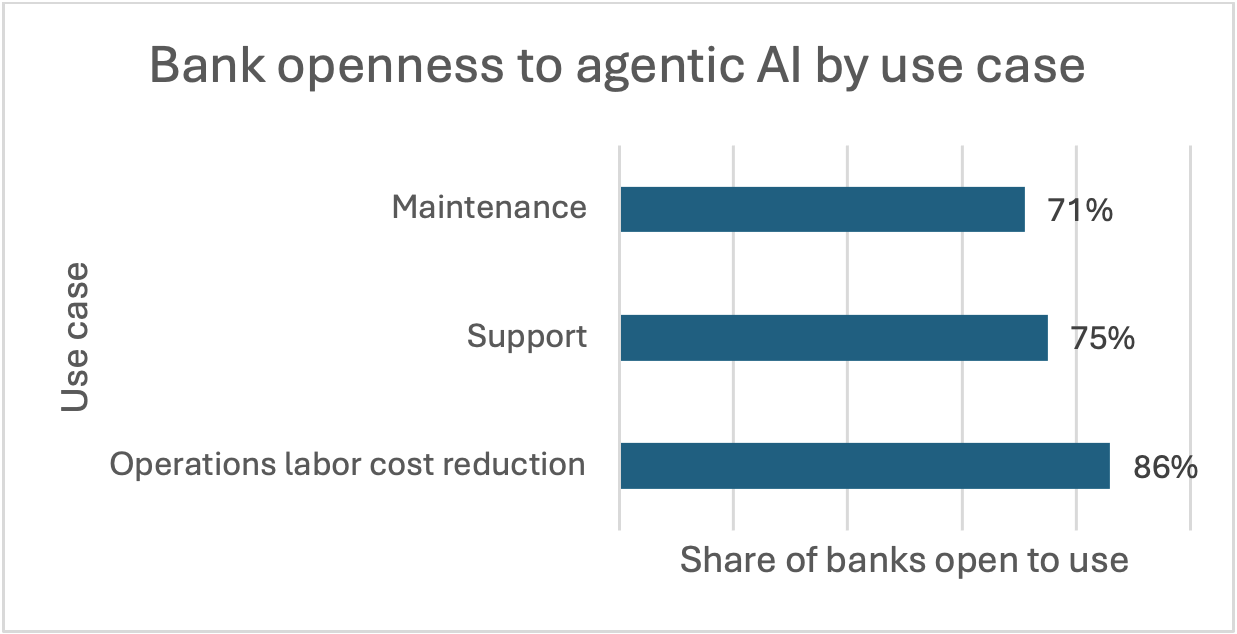
AI agents, meanwhile, will help banks detect issues and resolve friction early-on before they have the chance to reach the customer. A payment flagged incorrectly, for example, can be identified and repaired before it becomes a service issue. This kind of optimization is precisely where banks are prioritizing agentic AI.
Industry research shows where banks are most open to using agentic AI:
Looking ahead, we expect customers’ own AI assistants to begin interacting directly with banking systems – negotiating offers, verifying transactions and managing, or even executing, financial tasks (within defined guardrails).
Crucially, these advancements do not signal a replacement of existing digital banking processes – they augment and extend them. History shows that new channels rarely eliminate existing ones. The arrival of internet banking did not remove the need for branches, and mobile banking did not make web banking obsolete. Instead, each innovation expanded how customers interact with their banks.
We are seeing the same with AI. As banking becomes more deeply embedded in customers’ lives, AI can help banks to deliver more continuous, context-rich services while also unlocking new revenue opportunities, such as hyper-personalization (read more in our Banking Technology Trends report).