
Building an AI-Ready Bank

The foundations of an AI-ready bank
As outlined, AI is revolutionizing how banks operate, empower employees, and engage with customers. But competing successfully requires more than adopting new tools. It requires architectural modernization as well as a cultural shift in how banks lead on digital transformation. As Shireesh Thota, Corporate Vice President for Azure Databases at Microsoft, said: “It’s important to think of AI not just as an additional software feature. You’ve got to think of it as a fundamental institutional change.”
It’s important to think of AI not just as an additional software feature. You’ve got to think of it as a fundamental institutional change.
Shireesh Thota
Corporate Vice President for Azure Databases at Microsoft
From a technology perspective, there are nonetheless essential requirements. These include a conversational interface to enable natural, intuitive interactions; agentic AI frameworks to orchestrate tasks and decisions across systems; and unified data, underpinned by a knowledge graph, to provide the banking context and data the AI depends on.
These capabilities should be supported by API-first, event-driven architectures that connect front-office experiences to core banking systems in real-time. Connectivity is enabled through Model Context Protocol, which standardizes how context is shared between systems, models, and workflows.
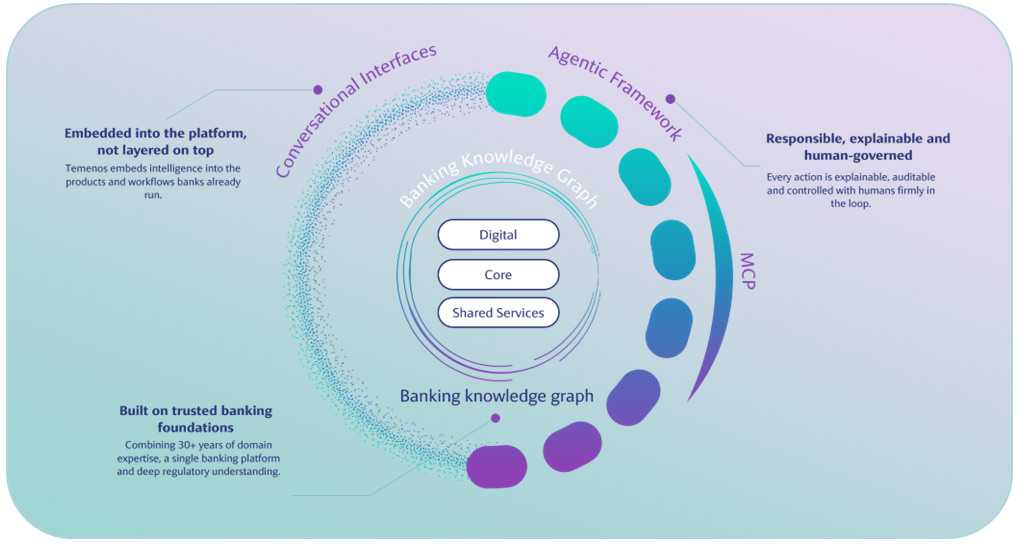
Without these, and particularly if core systems are outdated and run in batches, AI will, inevitably, be constrained by delayed, incomplete or siloed data. As was noted at TCF, while AI and automation can be applied to legacy systems, the results are likely to be limited. Modern platforms that support the above foundations are therefore critical because AI does not just elevate modern systems, it requires modern systems to be capable of delivering real value at all.
Data strategy is at the heart of it all. Banks need to be able to access data in real-time that reflects customers’ needs and circumstances (not just access to raw data, but the ability to interpret and act on it). Entities should also be connected through a usable ontology.
You have to define entities, figure out the ontology, define the schema, and then instantiate a knowledge graph on which you can create a unified fabric of intelligence.
Shireesh Thota
Corporate Vice President for Azure Databases at Microsoft
Model choice and platform design are equally important. As highlighted by Jochen Papenbrock, Nvidia’s EMEA Head of Financial Technology, open and interoperable models give banks flexibility, portability and control, making it easier to incorporate domain knowledge and tailor capabilities as needed.
Domain knowledge is important. To use domain knowledge, you need foundational, open-source models where you can tune them.
Jochen Papenbrock
EMEA Head of Financial Technology, Nvidia
Customizing and fine-tuning models in this way is key to standing out, Papenbrock added. This is how banks “capture uniqueness and competitive advantage”. Newer approaches such as sovereign cloud are also helping banks address local regulatory requirements while retaining control over their data and infrastructure.