Key Takeaways
- Strategic Equilibrium: Thai banks must shift from aggressive expansion to balancing the “iron triangle” of cost optimization, risk management, and strategic enablement amid modest loan growth and high household debt.
- Outcome-Based Banking: Boardrooms now demand tangible ROI from tech investments, with models like Toyota’s usage-based insurance embedding financial services into customer life goals rather than pursuing experimentation for its own sake.
- Legacy & “Build vs. Buy”: Over-customization has created costly “spaghetti architecture” (with up to 30% of project time spent on testing), prompting a strategic need to reduce “bespoke burden” by assembling best-in-class components instead of building everything from scratch.
- Hybrid Cloud as Digital Anchor: Hybrid cloud is the emerging consensus, balancing global AI innovation with Thai data sovereignty and geopolitical resilience—exemplified by SCBX’s 40.5% cost-to-income ratio.
- AI Governance Over Productivity: While AI offers 20-30% productivity gains, the real priority for Thai banks is security and credibility, requiring Sovereign AI Governance aligned with the Bank of Thailand’s risk guidelines and the nation’s push for Thai Large Language Models.
- Operational Maintenance to Strategic Mastery: Thai banking leadership must transition from keeping the lights on to actively navigating volatility, ensuring banks remain as sophisticated as they are stable—where the wisest, not fastest, transformers will win.
Introduction
The banking landscape in Thailand is evolving. Thailand’s major banks are forecasting modest, single-digit loan growth in 2026, household debt is sitting at 86.4% of nominal GDP, (leading the region in Southeast Asia), and geopolitical risks are compelling Thai banks to shift from aggressive expansion to disciplined efficiency.
Against this backdrop, the new paradigm facing Thai CIOs and CTOs is the need to balance between cost savings while laying the foundational capabilities required for the Bank of Thailand’s open banking future. With an average cost-to-income ratio of 40-50% amongst Thai banks and the bulk of IT banking spent funnelled into legacy systems like COBOL, the emerging opportunity for Thai bankers is in embracing a sustainable equilibrium, balancing innovation with deep-rooted prudence.
Success going forward is no longer about the most advanced tech stack available for Thai bankers, but about finessing between the “iron triangle” of cost optimization, risk management, and strategic enablement.
The ROI Reckoning – From Hype to Hard Numbers
Across Thai banking boardrooms, the shift is evidently moving from experimentation to measurable outcomes. Boardroom discussions today centre around growth, costs, and risks. The focus of building a modern technological stack has given room to a recognition of the need for tangible returns on tech investments. Thai bankers today need to showcasing results, particularly the tangible ones. For example, JP Morgan has boosted its tech budget by around US$2 Billion in 2026 with the bulk of the tech expenses coming from US$1.2 Billion in investments, including AI-related projects, yet CEO Jamie Dimon have stated that JP Morgan Chase now sees annual benefits from artificial intelligence matching its US$ 2 billion annual investment in technology. The ROI gap, however, remains elusive. IDC expects digital transformation spending by Asia Pacific banks to reach US$ 48.6 billion by 2027, but banks continue to find it challenging to report a tangible outcome. Commonwealth Bank of Australia (CBA) is an example for consideration. The bank reportedly spent AU$1.7 Billion a year on technology including AI processes. In 1H26, CBA reported a record cash net profit of 6%, with a 21% drop in loan impairment. CBA management noted that AI-drive scam and fraud detection has helped reduced customer fraud losses by 20% in the half. CBA stands as a plausible model of how tangible outcomes is now being increasingly demand for the tech investments spent by Asia Pacific banks.
Against the above backdrop, “Outcome-Based Banking” becomes the new buzzword. Outcome-based banking is a model where financial services are embedded into a customer’s specific life or business goals, utilizing technology like AI and data to guarantee or facilitate a predefined result (e.g., “becoming debt-free in 5 years” or “saving 20% on operational costs.”) Toyota provides a case study of Outcome-based banking through their Usage-Based Insurance (UBI) program. Using technology to track the goal of safe driving, customers are rewarded with lower insurance premiums. Toyota effectively changes their business model from premium collection to incentivising risk reduction via an ecosystem. This business model locks both Toyota as a financial institution and their end customer into a virtuous cycle of risk-reduction, rewarding both the bank and the customer for a positive outcome in their lifestyle. Toyota doesn’t just finance a car; they finance the outcome of a safe, green, and reliable journey. By integrating telematics into the loan, they turn ‘Risk Management’ from a back-office function into a customer-facing ‘Safe Driving’ incentive.”
The “Build or Buy” Paradigm & The Banking’s Spaghetti Architecture
With aged-old legacy systems accumulating technical debt and adding to the maintenance costs / complexity, customization takes on a fresh perspective. The adage of “we can build it” in an era where consumers are demanding Curated Consumption causes some degree of introspection. Instead of building the engine, should Thai banks be assembling the vehicle from the world’s best components for their Thai clients?
Experiences from industry consultants lend an interesting angle on this. Banking technologists have remarked that in recent projects there has been a trend of “undoing” the damage from over-customization. To build the greatest engine, some Thai banking projects have gotten themselves cornered with marked costs required to undo the infrastructure complexities. The legacy conundrum thus remains a paramount consideration. As much as 30% of a project’s resources could be spent on testing alone. Given the spaghetti analogy that models the typical banking infrastructure, the challenge of augmenting legacy data will be a top-of-mind consideration in any upgrading initiative. While the current ‘Era of Exhaustion’ feels heavy, it has created a unique strategic density. We are one catalytic event away from a structural leap ahead, a moment where the friction of legacy systems finally gives way to the fluidity of a truly digital Thai banking core. Thai bankers could consider a strategic “Bespoke Burden” to reduce their technological debt to accelerate ahead of their competition towards 2030.
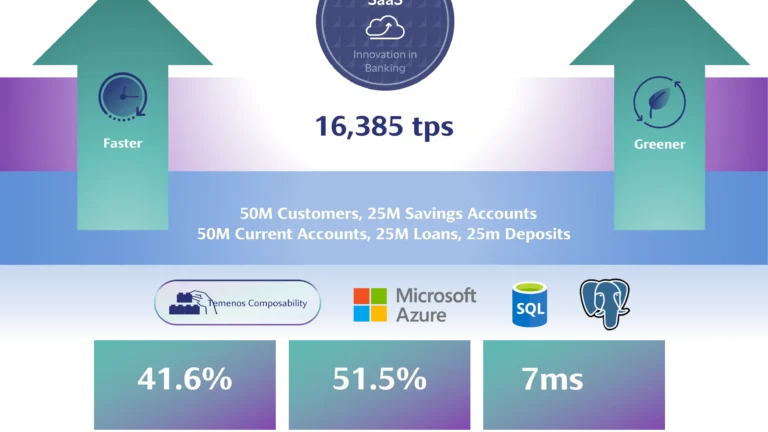
With a strong track record of delivering retail, corporate, wealth, and supporting banking solutions to financial institutions ranging from challenger banks to large-tier players across ASEAN and globally, Temenos is uniquely equipped to help Thai banks tackle this challenge. Its Temenos Composable Banking proposition embraces the Composable Banking philosophy, giving Thai banks the flexibility to build out capabilities incrementally — assembling independently deployable business components underpinned by Temenos’ deep, proven banking functionality. A key advantage of this approach is its ability to coexist seamlessly with a bank’s existing systems architecture, enabling a measured, low-risk path to modernization that sidesteps the operational, financial, and cultural burden of a full rip-and-replace.
The New Borderless Bank: Reconciling Cloud Innovation with Geopolitical Reality
For many Thai bankers, the strategic calculus lies between balancing infrastructure and sovereignty. While some camps would advocate the view of a cost-effective cloud infrastructure, as seen in BDO’s “SaaS first, cloud next, and on-prem last” strategy, it is notable that SCBX has achieved a 40.5% cost-to-income ratio in 2026 while balancing cloud-native innovation with aggressive cost-to-serve optimization. Their strategy emphasizes “infrastructure readiness” for their upcoming virtual bank, which utilizes a hybrid approach to maintain low overheads.
Thai banks are trending towards the hybrid cloud as Thailand continues its path towards digitalization. Industry experts suggest that if applied incorrectly, public cloud costs could be higher than staying on premises, with the hybrid model enabling banks to avoid the “complexity tax” with unmanaged cloud spends. Cloud adoption amongst Thai banks continues in its nascent stages, and the potential of the cloud for good has yet to be uncovered. The main obstacle is the large quantity of legacy applications in banking systems, making integration with a new system complex. Additionally, the skill gap in implementing a digital strategy is a considerable one in Thailand.
Yet within Southeast Asia, self-dependency continues as a trend amongst its leading banks. ASEAN banks are weighing the cost benefits of the cloud against the risks of war and geopolitical tensions disrupting a 100% cloud strategy. The Bank of Thailand (BOT) has set stricter directions for data technology risk management, making hybrid models the most plausible approach towards leveraging global AI tools while keeping core banking data local. In this context, data sovereignty and recovery becomes a strategic imperative, not just as regulatory checkbox. Thai bankers could draw inspiration from the Bank of Japan (BOJ)’s business continuity protocols as a standard for recovery during black swan events. In the 2011 Tokyo earthquake, the BOJ switched over to the Oaska centre within two hours, after which BOJ-NET resumed full operations. Despite a 9.0 magnitude quake, staff at the Sendai Branch could resume critical liquidity operations essential in enabling Japan’s rapid recovery post-disaster.
In an era of shifting global currents, a Hybrid Cloud strategy is the ‘Digital Anchor.’ It allows Thai banks to harness global innovation while ensuring critical data remains firmly under Thai sovereignty and protection. Hybrid Cloud isn’t just a technical choice; it’s a balanced path between global reach and local security.
Recognising the geopolitical and regulatory constraints faced by Thai banks, Temenos offers a truly flexible consumption model for its Temenos Composable Banking proposition. Built on a cloud-native, cloud-agnostic foundation, Thai banks can choose to self-host on-premises within their own private data centres or leverage public cloud platforms such as AWS or Microsoft Azure. This deployment freedom empowers Thai banks to navigate the realities of data sovereignty and cross-border regulation while modernizing at a pace and through a model that aligns with their strategic, operational, and compliance needs.
The New Trust Equation: Architecting Governance in the AI Era
Following an initial phase that established data governance and ethical foundations, the Thailand Nation AI Strategy and Action Plan is entering its second phase, pivoting to active implementation and focusing on national flagship projects across key sectors including finance. The Thai government is pushing for “Thai Large Language Models,” to ensure that cultural and linguistic nuances in AI aren’t dictated by non-native codes. Thai bankers today need to strategize for a pragmatic approach to AI and the new risks it introduces.
KPMG noted that on average, Thai banks could expect a 20%-30% gains in productivity from AI. But in an ‘era of exhaustion,’ the real objective may not be productivity, but security and credibility. The Bank of Thailand (BOT)’s rigorous new focus on ethical boundaries of AI through its AI Risk Management Guidelines brings the issue of a critical digital infrastructure back again front and centre. The momentum is clearing shifting from cultural adjustments to AI towards security concerns and governance of AI for Thai banks.
Banking leadership beyond 2026 requires a fundamental transition from ‘Operational Maintenance’ to ‘Strategic Mastery.’ To truly safeguard the Thai consumers, Thai banking cores must possess the agility to navigate increasingly volatile global currents. Consequently, a Sovereign AI Governance framework without refreshed technical capabilities creates a ‘resilience gap’ that puts both national interests and the Thai financial sector’s sanctity at risk. As the engines of Thailand’s future, Thai banks must remain sophisticated as they are stable.
Conclusion: The Equilibrium Advantage
For Thai banking leadership, the 2030 horizon demands more than a choice between innovation and prudence; it requires their deliberate fusion. In an environment of elevated household debt and calibrated loan growth, the pursuit of the ‘latest’ stack has matured into a pursuit of Strategic Equilibrium. Whether the issue is refining ROI through outcome-based models, resolving legacy complexities to lift ‘bespoke burden,’ or anchoring hybrid cloud models against global volatility, the mandate remains one of Stewardship. Thai bankers must transition from operational maintenance to Strategic Mastery ensuring that Thai banks remain the sophisticated, stable, and sovereign engines of Thailand’s future. The winners of this era will not be the fastest to transform, but the wisest.