Introduction
Banking is evolving. Facing stringent regulations, cybersecurity risks, and fierce competition, thrift banks must navigate significant headwinds for sustainable growth. In the Philippines, rapid digital transformation and shifting customer expectations have made hybrid banking (blending traditional and digital services) essential for survival and growth. Yet, hyper-digital banking can’t be achieved alone. It requires collaboration across regulators, tech partners, and the collective wisdom of the thrift banking community. For Filipino thrift bankers, resilience now means adapting, innovating, and thriving in a dynamic landscape.
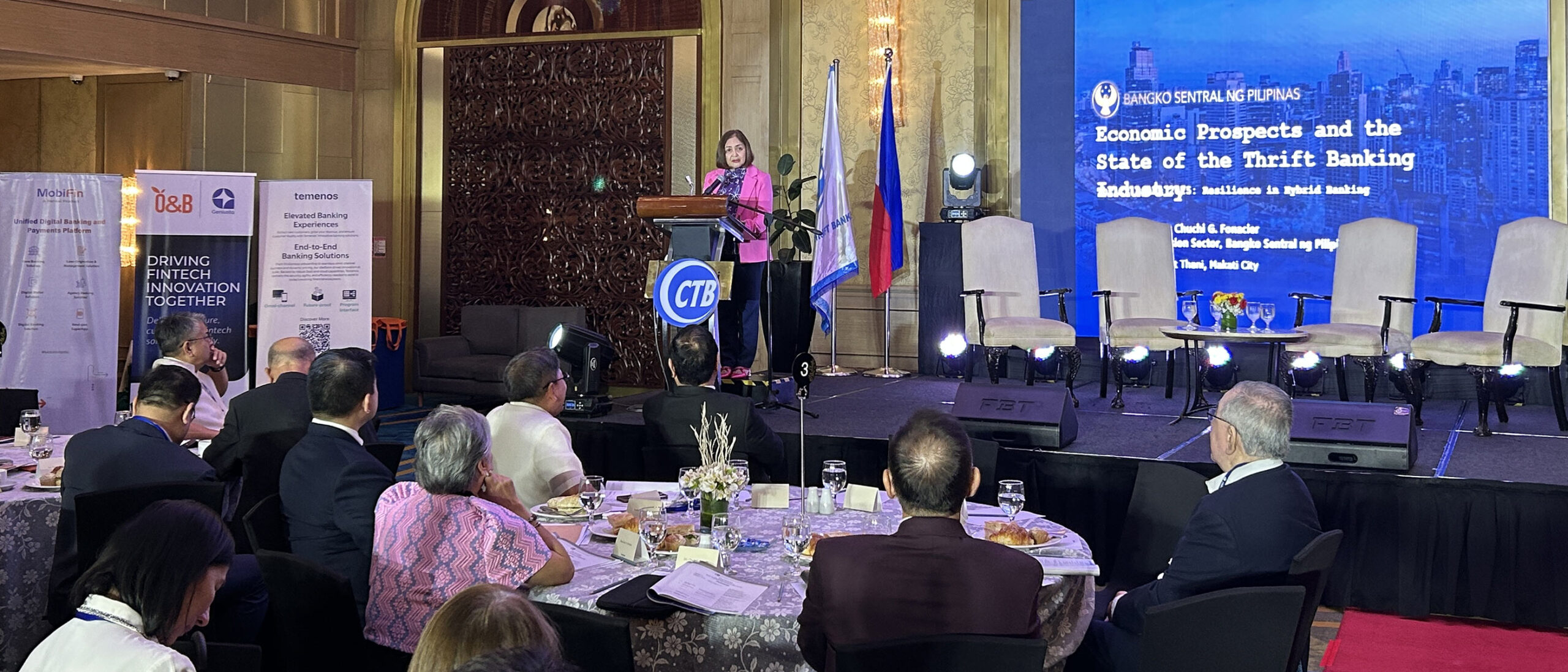
That’s why Temenos proudly supports the Chamber of Thrift Banks Convention 2025. We believe thrift bankers need a shared platform to drive bold, forward-thinking strategies. Our goal is to equip thrift bankers with the know-how of what technology can do to enable them to attract and respond to customer needs, grow revenue, deepen customer loyalty, and deliver inclusive, secure financial services. By fostering shared learning, cross-referrals, and providing scalable solutions, we’re committed to helping thrift banking succeed in the digital era, championing trust, the Filipino perspective, and better banking for the Philippines.
A resilient banking community
The Thrift Banking community in the Philippines has thrived for over half a century. Kevin Kelly’s concept of perpetual evolution, particularly in the context of technology, suggests a continuous, self-improving, and interconnected system[1], an apt metaphor for the thrift banking community in its mandate to provide quality financial services for the unbanked and underbanked in the Philippines. This year’s theme of “Resilience in Hybrid Banking” affirms Thrift Bank’s community’s need to balance personalised services with digital innovation to meet customer needs and mitigate risks.
The Bangko Sentral ng Pilipinas (BSP) projects that inflation would remain below the 2–4% target until Q4 2025, rising thereafter[2]. Global uncertainties—such as U.S. trade policies and Middle East conflicts are likely to dampen domestic demand, as seen in softer PMI figures and a slight uptick in unemployment. Despite this, consumer sentiment shows cautious optimism, with low inflation potentially supporting near-term recovery. In the backdrop of this, the Thrift banking community have outpaced pre-pandemic growth, with assets reaching ₱1.1 trillion (8.5% YoY)[3] and loans comprising 70.4% of assets (₱823.3 billion)[4], primarily supporting households, real estate, and retail trade. Capital adequacy ratios[3] (17.8% solo, 20.1% consolidated) and liquidity buffers remain robust, ensuring resiliency against external economic shocks.
The Thrift Banking community has also seen a rise in rapid digital adoption, with 73.2% of thrift banks holding e-payment licenses and significant participation of 48.8% with InstaPay and 43.9% on PESONet[4]. Riding on the momentum, the Chamber of Thrift Banks now focuses on a possible double-digit growth this year with a significant push towards hybrid banking. Hybrid banking, however, does come with the risk of a fragmented experience. As Filipinos become more tech-savvy, online services from one sector can create new expectations for Thrift banking. In a study conducted by Temenos, 52% of banking executives acknowledge that changing customer expectations is a top driver for digital transformation, affirming that view for Hybrid banking as a practical approach for Thrift Banking.
With the right tools, Thrift Banks can potentially offer seamless, personalised, and efficient banking experiences across all channels in hybrid banking. Today’s banking technology can enable Thrift Banks to enjoy cost-effective, hyper-personalised banking services across multiple channels, even with data analytics and AI. Alex Bank, for example, have created an innovative, real-time credit decision system called Alex Intelligence, which uses data analytics to assess an applicant’s credit risk. The result of their innovation is a 2-minute 40-second loan decision compared to their competitors, a 2,100% growth in their deposit portfolio, and a 66% growth in their lending portfolio since receiving their license from the Australian Prudential Regulatory Authority (APRA)[5].
As the Thrift Banking community continues to evolve and embrace hybrid banking, balancing its meticulously well-guarded traditions and values with an exciting blend of cutting-edge innovation is painting a vibrant and positive future for Thrift Banking in the journey ahead.
Digital payments, a key focus
The Filipino Thrift Banking community continues to play a vital role in promoting financial inclusion, particularly in supporting MSMEs, housing, and consumer finance. They bridge the gap between large commercial banks and the economic needs of everyday Filipinos, leveraging strong client relationships and deep market understanding to drive digital adoption. In part because of the ongoing good work on the Thrift Banking community in financial inclusion, the Philippines has seen a significant shift from cash-based to digital payments. In 2023, the Bangko Sentral ng Pilipinas (BSP) achieved its goal of converting 50% of retail payment volumes to digital[6], driven by online merchant transactions, peer-to-peer remittances, and business supplier payments. A key milestone was the launch of QRPH, a standardised QR code system to replace proprietary solutions[7].
While the Philippine Development Plan aims for a greater volume of digital retail payments by 2028[8], achieving this requires systemic transformation, expanding participation in digital ecosystems like PESONet[9] and InstaPay[10], and addressing adoption barriers. The BSP have identified four major consumer concerns in uplifting the volume of digital payments:
- a) High transaction fees → Addressed via BSP’s fair pricing guidelines (Memorandum 2024-015) and an upcoming policy on reasonable e-transfer fees.
- b) Security risks → Strengthened by the Anti-Financial Account Scamming Act (FAASA) and consumer redress mechanisms (BSP Circular 1195).
- c) Limited merchant acceptance → Expanded through QRPH and BillsPH (interoperable bill payment system).
- d) Poor internet connectivity → Mitigated by exploring offline payment solutions for low-connectivity areas.
While some of the above concerns would require a systemic approach to create an environment that spurs further digital payments adoption, technology could address the concerns of high transaction fees and security risks. Recognised as #1 across 13 categories in the IBSi Sales League Table 2025, including Retail Payments, Digital Banking and Channels, we have partnered with leading financial institutions across the globe to provide lower cost routings, leading to quicker time to market, faster payment deliveries, and a better frictionless customer experience.
While the BSP is exploring a B2B (business-to-business) instant payment use case, tailored for SME supplier payments and commercial transactions, Temenos is proud to say that our payment solutions is capable of supporting all domestic transactions defined by the BSP, with the capability to process millions of transactions per day. It provides a platform that enables banks to lower the overall per-transaction cost due to the platform’s scalability.
Temenos Software as a Service also provides a scalable, cloud-native digital payments platform purpose-built to help Thrift Banks streamline payment processing, enhance customer experiences, and drive digital transformation. With built-in regulatory compliance enablement, the platform delivers enterprise-grade security, high availability, and elastic scalability—ensuring operational resilience and business continuity. By adopting Temenos’ modern SaaS delivery model, Thrift Banks can confidently mitigate the security and operational risks identified by FAASA, while establishing a secure, future-ready foundation for efficient digital payment.
Conclusion
The future of thrift banking in the Philippines isn’t just about adaptation—it’s about reinvention. As we stand at the intersection of tradition and innovation, hybrid banking emerges as the launchpad for a bold new era, where personalized service meets AI-driven efficiency and digital-first experiences. With soaring digital adoption, resilient economic foundations, and visionary regulatory support, thrift banks are poised to lead a financial revolution—one that expands inclusion, empowers businesses, and transforms how every Filipino banks. Technologies like cloud-native platforms and real-time analytics aren’t just tools; they’re gateways to seamless, secure, and hyper-personalized banking. The path forward is clear: by embracing collaboration, cutting-edge solutions, and an unwavering commitment to customer trust, the thrift banking community won’t just navigate change—it will define the future of finance in the Philippines. Together, the Thrift Banking community and Temenos are leading the way forward, and we’re building more than resilience; we’re creating a brighter, fairer, and more connected financial world for everyday Filipinos. Our next chapter starts now.
[1] The Next 30 Digital Years: Insights from Kevin Kelly
[2] BSP projects inflation to remain within gov’t target until 2027
[3] Philippine thrift banks grew total assets by 6% to $19.5b t in 2024
[4]Thrift banks prepare to go hybrid, see possible double digit growth
[6] Philippine central bank achieves digital retail payments target
[7] The Philippines: Driving Digital Payment Adoption Across NCR
[8] Unlocking the Philippines’ Digital Transformation by Increasing Internet Connectivity
[9] BSP, Payments Industry Enhance Settlement of E-Payments

Temenos SaaS
Access to leading banking solutions, proven and resilient as-a-service.