7 Key Trends Driving Wealth Management in 2023

Download Whitepaper

The most progressive and forward looking financial institutions will use this period as a time to refine their strategy.

To identify key trends and invest. To increase operational efficiency and to minimize unnecessary costs. To enhance their product and service offering and, by doing so, to emerge in a strong position as normality resumes.

These are just some of the key trends that we anticipate will be top of mind for key decision makers in wealth management throughout 2023.

The Generational Wealth Transfer

With an estimated 40 to 60 trillion dollars set to change hands from the original baby boomers to their Gen X and Millennial children, this trend will remain of critical importance to wealth managers focused on higher net worth clients.

Environmental, Social & Governance (ESG) compliant frameworks

Multiple studies have shown that a younger generation of investors are seeking investments that reflect their underlying values and those that are not willing or unable to address client demands for ESG compliant portfolios risk losing those clients to other service providers.

Individual and Team Mobility

Hybrid working models and digital collaboration tools have granted the flexibility to make new engagement models possible and in some cases, these may become a preference for both advisers and their clients.

Fintech Adoption

With rising costs and clients demanding

more than ever, wealth managers, especially those in larger and less specialized customer segments, will recognize that the rapid ability to enhance a product or service offering may best be achieved by outsourcing to a specialist service provider or vendor.

API-ification

The increase in the use of APIs will allow wealth managers to offer more targeted and relevant solutions and services to multiple client segments, and for global or multi-region providers, across multiple geographies.

Hyper-personalization

The ability to leverage existing customer data in a structured manner will enable the creation of insights that may lead bespoke or semi-bespoke proposals. These will, at the very least, create a perception of a unique, tailored offering that if formulated correctly, is more likely to appeal to the selected sub-set of customers.

Personalized or custom indexing

Reflecting rising trends focused on hyper-personalization and ESG, we see a rapid growth in personalized or custom indexing. Advances in technology have helped to ease the associated administration burden making this financially viable for a new range of potential investors.

About the author

Eric Mellor is a wealth specialist at Temenos, responsible for bridging the gap between customers and vendors, working with banks to define their wealth management goals and ambitions and translating these to practical, effective technology-driven solutions.


7 Key Trends Driving Wealth Management in 2023

Download Whitepaper

With the rapid evolution of artificial intelligence (AI) in the financial services in recent years, banks continuously strive to get ahead in hyper-personalizing customer experience to empower customers to “live more” and “bank less”, as one of Southeast Asia’s top banks very aptly put it.

There is no doubt AI has brought benefits to consumers, businesses, and the wider economy. However, AI has also amplified risks and created new challenges and will continue to do so as AI models get more sophisticated.

With this background, we have identified 5 key trends that banks will be focusing their efforts and investments in the area of AI.

Governance

Governance of AI has been found to be more effective if it embraces diversity of skills and perspectives and covers the full spectrum of functions. This cross-functional mitigates the AI complexity and related data challenges. 

Managing Data

Owing to the nature of the XAI algorithm and the fact that outcomes and drivers of XAI are fully explainable, the uncovering and understanding of latent data quality issues can happen during XAI model developments, which supplements up-stream data management efforts creating a virtuous circle.

Managing Model Risk

AI models can create risks that arise from complex inputs, inter-variables relationships, the algorithm itself, and even the ensuing outputs. Hence, explaining AI model output is critical and more so in the financial industry as regulators keep a keen watch to proactively prevent the pervasive use of AI from causing a systemic risk to the banking system.

Barriers to Adoption

While AI can be deployed in many business scenarios, and that has been the case, the barriers to AI adoptions, especially for smaller banks, can still be significant. High on the list are the barriers involving data, documentation, explainability and governance. AI can magnify existing risks and introduce new challenges resulting in more controls and structures.

Optimized Explainability

“Explanation” depends on context, a good explanation for a customer is very different from one to data scientist or bank executive. This explainability gap require consistency to facilitate understanding among the different stakeholders and there is an already increasing calls for this level of explainability.

About the author

CK Loy

CK Loy is a Principal Solutions Consultant at Temenos. Based in Singapore, he is also Temenos’ Global Domain Lead for Analytics and XAI. Earlier in his career, he was a banker where he led analytics teams in areas of portfolio management, analytics and modeling. He then joined the fintech industry in 2014 to continue his efforts on empowering banks to leverage data, analytics and AI to enhance financial inclusions and business successes.


View the Webcast

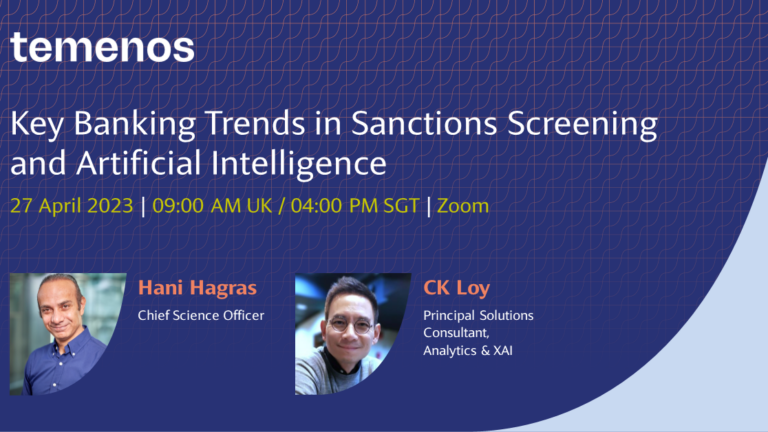
Our expert speakers, Hani Hagras and CK Loy, discussed the latest trends and technological advancements in AI, with a particular focus on how it can help financial institutions mitigate risk, increase efficiency, and modernize their Sanctions Screening processes to fight financial crime.

7 Key Trends Driving Wealth Management in 2023

Download Whitepaper

Corporates have long been banking’s most profitable customers and banks continue to strive to provide the best service to the sector. A recent report found the global corporate banking market is expected to grow at a CAGR of 7.5% from 2022 to 2027 – presenting huge potential and opportunity.

As banks undertake their digital transformation journeys, in the corporate banking sector the objective is to enable corporates to become increasingly sophisticated in all aspects of banking, from cash management, supply chain finance, to liquidity management and much more. To do this, banks have had to undertake a paradigm shift in their customer experiences and internal processes, moving from product-centric to customer-centric, where the customer is placed at the heart of the process. And to enable and support these often complex transformations, addressing legacy technology and ever-changing customer needs, to name only a few challenges, banks are turning to their digital technology partners for the latest advanced technologies.

Padmani Koteeswaran, APAC Principal Solutions Consultant, discusses top corporate banking trends likely to be adopted by financial institutions globally in 2023.

Devising The Digital-First Strategy

Harnessing The Power of Data

Providing End-to-End Solutions 

Adopting Contemporary Technologies

About the author

Padmani Koteeswaran is a Principal Solutions Consultant at Temenos in APAC, with over 18 years of digital banking solutions expertise. Padmani is passionate about helping financial institutions with solutions that bring benefits to the business and their customers as the need of the hour is a rock-solid foundation for sustainability.

Download the white paper today to find out more:


7 Key Trends Driving Wealth Management in 2023

Download Whitepaper

Gartner estimates $195 Billion of spending across industries on Cloud Application Services in 2023, with Financial Services set to be one of the key contributors to this overall estimated spend.

As banks seek to cut costs and ramp up digital transformation, cloud adoption by banks has accelerated. Just under three-quarters (72%) of IT executives at banks surveyed by The Economist Intelligence Unit in 2021, report that incorporating the cloud into their organization’s products and services will help them to achieve their business priorities. 82% of banking IT executives say they have a clear strategy for adopting cloud technology.

Here are five Software-as-a-Service (SaaS) trends will drive increased adoption of cloud in 2023, and beyond.

Migration to SaaS

Banking services SaaS

Empowerment through SaaS self-servicing

Evergreen SaaS Cybersecurity

SaaS Based ESG

About the author

Zannettos (Zan) Zannettou

Zannettos (Zan) Zannettou is a Principal Solutions Consultant at Temenos in APAC, focusing primarily on SaaS based solutions, with over 25 years of banking solutions expertise. Zan is a passionate advocate of cloud-based SaaS banking solutions, given the many benefits that financial organizations can realize in adopting SaaS solutions

7 Key Trends Driving Wealth Management in 2023

Download Whitepaper

It is a challenging time for Retail Banks who have only now started to recover from the aftermath of the pandemic and are now facing an economic crisis. The Russia-Ukraine conflict has resulted in an unprecedented rise in inflation and tightening of monetary policy across the world with a potential for a mild recession or stagflation.

A new global economic order seems imminent and innovation has to be a critical component in the strategy for the banking industry. Innovation here not only means creating the ‘next big thing’ but also means modifying products, services or processes which create value.

This white paper aims to share with you some of our insights on the top five retail banking trends likely to be adopted by financial Institutions in APAC.

Embedded Finance

Embedded banking bridges the gap between financial services and end consumers and makes access to financial services faster and hassle-free manner without going to the bank.

Shift to the Cloud

Legacy technology is not only challenging to upgrade regularly but also costly to maintain. The customer experience even after so much effort may be sub-par. Cloud computing solutions will improve the speed of operations as well as increase the capacity to scale.

Experiential Banking

During the pandemic customers became increasingly digital and connected and now expect a hyper-personalized customer experience. As a next step the customer is looking for lifestyle and contextual experiences.

Banking-as-a-Service (BaaS) Approach

BaaS essentially creates new revenue models for banks by leveraging their

existing investments. In BaaS, licensed banks integrate their digital banking services into the products of non-banking services. BaaS should not be confused with embedded finance as it is broader in scope.

Personal Interactions

After the pandemic the customer are looking for more human interactions. Personalized and digital self-services are a good step forward but they need to be blended with a human touch.

About the author

Ravi Bhutra is a Principal Solutions Consultant at Temenos APAC and the Retail Banking domain lead globally. He is based in Singapore. Prior to this, he has worked extensively in the Banking Sector, with a decade of hands-on experience in Branch Management, Relationship Management, Front Office, Retail Operations, AML, Compliance and Trade Finance. He moved to Presales over 18 years ago and has been with leading core banking providers globally for channels, retail and corporate banking, as well as wealth management.

7 Key Trends Driving Wealth Management in 2023

Download Whitepaper

Asset Management Whitepaper:

How to Build Your Long-term IT Strategy?

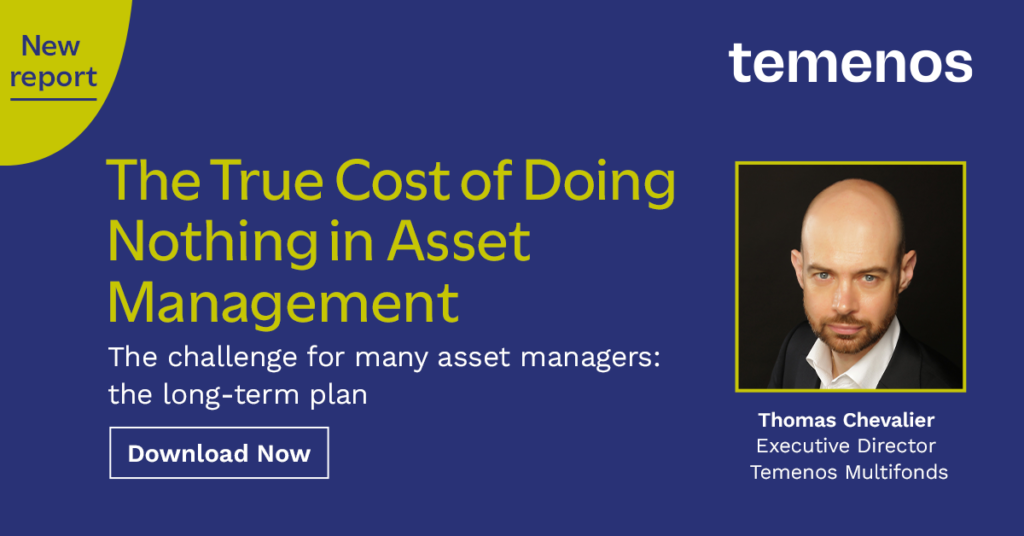
The asset management industry as previously known has changed forever. For the last two years, the industry has faced a time of unprecedented demands that will ultimately produce new winners and losers.

The growing interest in new asset classes, new geographies, cryptocurrencies, ESG and more, mean many asset managers are adapting their portfolios and investment strategies. But whilst the front-office is getting excited about new products & services, new software & systems, is the back-office ready? And if not, why not?

Asset management white paper

Read this paper and uncover insights from the key pressing topics in the industry:

  • New winners and losers: What’s the biggest risk of delaying change?
  • Modern platform approach for technology decision-makers: from buy & build, to extend & assemble?
  • The reality of in-house projects: is it actually more flexible at lower costs as initially assessed?
  • The biggest challenge of long-term plan: how to resolve the contradiction of adopting a long-term IT strategy VS short-term cost-cutting?
  • Build your strategic roadmap: from API frameworks to broader ecosystem, get ready for your evolving clients offering

You can also learn more about Temenos Multifonds solutions here:

Download white paper now

Thank you for your interest, if you have any specific enquires, feel free to put in below box and one of our dedicated consultants will reach out soon.

Learn more about Multifonds

Temenos Launches a Dynamic NAV Oversight and Contingency Solution for Asset Managers

The new cloud-based subscription service provides independent, automated NAV oversight and contingency to address increasing calls for operational resilience and auditable oversight

Canada Life UK Goes Live with Temenos Multifonds

The assurance and pensions firm will administer more than £40 billion of assets on the Temenos fund accounting platform

Temenos Extends Partnership with Standard Chartered to Enhance the Bank’s Financing & Securities Services Offering

With Temenos Multifonds, Standard Chartered has extended its services with the latest functionality to support alternative assets, leveraging automation to create new operational efficiencies


7 Key Trends Driving Wealth Management in 2023

Download Whitepaper
Temenos Composable Banking Platform

A multitude of banks are already using Composable Banking Services to drive innovation and build revenue. One such bank is Garanti BBVA International. Thanks to Temenos’ composable banking platform, they became one of the first Netherlands banks to use the public cloud for processes and client databases. This gave them greater business agility, better operations, and lower costs – a perfect environment to bring innovation to market faster.

Composable Banking Services come with three main benefits:

Time to innovate

Your development teams can launch new services and products in days. These services are built on industry-standard software, and can run in any cloud environment, meaning you don’t need to create new delivery mechanisms for each innovation.

Agility and scalability

Each capability is an independent entity, able run without relying on anything else. This means you can deploy them (and withdraw them) quickly. And they can be scaled up and down automatically in line with changing demand.

Control over costs

Development costs often spiral out of control when launching new customer-facing innovations. That’s not the case with Composable Banking Services. These give you far more control over your budget since you choose from capabilities that already exist, and you only pay for what you need and use

Temenos composable banking platform

“With Composable Banking customers have countless tools at their disposal to craft the perfect solution for their banking firm. Through constant learning, we realise the further potential in our capabilities and get to celebrate the success of our customers.”

Temenos’ EVP & Global Head of SaaS and PartnerEco system, Ross Mallace, is a huge advocate of the transformative impact Composable Banking Services are having on banks today

Added assurance and security from Microsoft

Temenos has also partnered with Microsoft to ensure that our Composable Banking Services run on the most flexible and secure cloud platform out there.

Composable Banking customers

“Our partnership with Temenos creates solutions that enable banks to evolve their services and systems. Temenos’ Composable Banking solution provides the client with a sandbox of ready-to-use components that can future-proof solutions, to best fit their customer’s needs. While the additional value of Microsoft Cloud provides a solid backbone for scalability and agility.”

Peter Hazou, Business Strategy Leader of Worldwide Financial Services at Microsoft, this offers significant advantages for our banking customers

Download our newest whitepaper to gain more insights in how the Temenos Banking Cloud and our Composable Banking Services can help you to innovate faster at reduced costs.

7 Key Trends Driving Wealth Management in 2023

Download Whitepaper

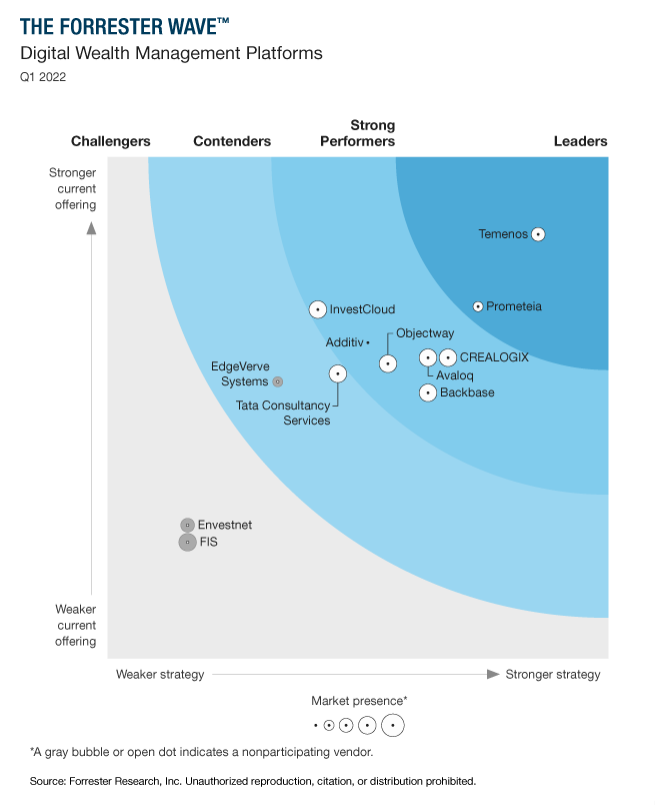
“Temenos stands out for its end-to-end digital wealth management capabilities. Temenos excels in most areas of product functionality and has a roadmap and planned enhancement to ensure they will continue to do so. Temenos is a good choice for financial institutions (FIs) worldwide looking for broad business capabilities, strong data analytics, and a vendor with access to a global partner community and large marketplace of fintech solutions through its Temenos Exchange platform.”

Temenos was named a leader among Digital Wealth Management Platforms (DWMP) according to The Forrester Wave™: Digital Wealth Management Platforms, Q1 2022. According to the report, “Temenos’ wealth platform offers broad, off-the-shelf business capabilities along with access to a broad array of third-party fintech solutions.”

Temenos was evaluated among the 12 most significant vendors in the Digital Wealth Management Platforms (DWMP) market.

Download the report to learn more about why Forrester recognizes Temenos as a leader among Digital Wealth Management Platforms.

Download Report

The Forrester Wave™: Digital Wealth Management Platforms.

7 Key Trends Driving Wealth Management in 2023

Download Whitepaper

7 Key Trends Driving Wealth Management in 2023

Download Whitepaper

Banks are bullish that artificial intelligence (AI) will help them achieve their business priorities, fuelling back-office efficiency gains, product innovation and new business models. Our recent survey with The Economist Intelligence Unit (The EIU) found technology decision-makers have a “clear strategy” for using AI to achieve their goals. But on which business areas are banks focusing their AI investments, what barriers to adoption remain and what is the role of explainable AI in the future of banking?

Together with The EIU, we sought the answers to these questions and more in a new report: Banking on a Game-Changer – AI in Financial Services, incorporating data from over 200 global banking IT executives.

Key Findings

  • Four in five (81%) of IT executives in banking agree that unlocking value from AI will distinguish winners from losers
  • 85% have a “clear strategy” for adopting AI in the development of new products and services
  • 78% of IT executives report that incorporating AI into their organization’s products and services will help them achieve their business priorities, 46% say “to a great extent”
  • 62% of bankers agree that the complexity and risks associated with handling personal data for AI projects often outweigh the benefits to customer experience

Download The Report